
The Tides That Turn Us
Chapter 1 · The Unravelling

The fluorescence of the fortieth floor hummed a migraine into Zoe’s temples. It was a familiar ache, a dull throb that had become the background music to her life. Outside the panoramic window, the city sprawled in a glittering, indifferent tapestry of light and steel. It was beautiful, she supposed, in the way a perfectly executed algorithm was beautiful: complex, efficient, and utterly devoid of warmth. At forty-three, Zoe was a master of algorithms, both digital and human. She knew how to streamline a workflow, how to de-escalate a boardroom conflict, how to arrange her face into a mask of serene competence while her insides churned with the acidic anxiety of a thousand unspoken pressures.
Her silk blouse, a tasteful shade of dove grey, felt less like a garment and more like a carefully constructed shell. Her suit jacket was draped over the back of her ergonomic chair, a silent testament to the ten hours she had already put in today. On her screen, three different project management platforms vied for her attention, a chaotic constellation of deadlines, dependencies, and demands. Her phone buzzed on the polished mahogany of her desk, a relentless vibration against the wood. She didn't need to look to know who it was. Mark.
She let it go to voicemail, a small, futile act of rebellion. A moment later, the icon for a new message flashed. Zoe, call me. Urgent.
With a sigh that felt scraped from the bottom of her lungs, she tapped the screen. Mark’s voice, artificially buoyant, filled her ear. “Zoe! There you are. Listen, I need you on the first flight to Geneva in the morning.”
Zoe closed her eyes, picturing her calendar. This weekend was supposed to be hers. Two glorious, empty days blocked out in pale yellow: Personal Retreat. She’d booked a small, quiet hotel in the countryside with a spa. She’d pictured massages, long walks, and the profound luxury of not speaking to another human being unless she wanted to. It was the only thing that had gotten her through the last quarter.
“Mark, this weekend is…” She trailed off, already knowing how the words would sound. Weak. Uncommitted.
“Is what? Listen, the Atherton deal is getting squirrelly. They need some hand-holding, the C-suite to C-suite touch. You’re the only one who can smooth this over. It’s Saturday, what could you possibly have planned that’s more important than landing a nine-figure contract?”
The dismissal in his tone was absolute. Her two days of planned sanity, her one small grasp at restoring a piece of herself, was reduced to a triviality. What could you possibly have planned? A life, she wanted to scream. I had planned to have a life.
“My sister’s fortieth birthday,” she lied, the words tasting like ash. A lie was armor; the truth—that she was simply exhausted to the point of breaking—was a vulnerability she could not afford.
Mark didn’t miss a beat. “Send her a case of champagne. The really good stuff, on the corporate card. Your flight is at 6 a.m. The car will be at your place at four.” He chuckled, a dry, grating sound. “Get some sleep, Zoe. You’re our superstar.”
The line clicked dead.
Zoe stared at the phone in her hand, a sleek black rectangle of glass and metal. Superstar. The word echoed in the silent, pressurised air of her office. She felt less like a star and more like a spent husk, hollowed out and polished for display. Something inside her, a cord that had been fraying for years, stretched taut and then, with a silent, seismic shudder, it snapped.
It wasn't a dramatic event. There was no shouting, no throwing of papers. It was a profound and sudden quiet that fell over her. The hum of the lights faded. The incessant digital chatter of her life receded into a dull, distant roar. She looked at her reflection in the dark glass of the window—the severe line of her tailored trousers, the impeccable knot of her chignon, the tired, haunted eyes staring back. She didn't know that woman. She had built her, piece by piece, success by success, but the architect had long since vacated the building.
With a slow, deliberate movement, she closed the project management tabs. One by one, the glowing red notifications and urgent flags vanished. Then she opened a new browser window. She didn't type in the name of an airline or a hotel chain. Her fingers, acting of their own accord, typed "quiet coastal towns."
A list appeared. Names she’d never heard of, places that sounded more like poems than destinations. Seabrook. Saltwind Harbor. Peregrine Cove. She clicked on the first one, Seabrook. A travel blog appeared, filled with photos of windswept dunes, a craggy shoreline, and a small town that seemed to huddle against the vastness of the sea. The article described it as "a place where time moves at the pace of the tides."
The pace of the tides. Zoe couldn’t remember the last time her life had a pace other than frantic.
She found a rentals site. A small cottage, perched on a low bluff overlooking the water. It was called Saltwood Cottage. The photos showed a weathered cedar-shake exterior, a stone fireplace, and a wide, covered porch with two simple wooden chairs facing the ocean. The description was brief: "One bedroom, one bath. No Wi-Fi. Excellent signal for a personal hotspot if you must, but we encourage you to disconnect."
Disconnect.
She scrolled to the availability calendar. A month-long block, starting tomorrow, was inexplicably open. It felt like a sign, a door left ajar in the wall of her life. Her finger hovered over the ‘Book Now’ button. The logical part of her brain, the part that had earned her a corner office and a portfolio that would make her father proud, screamed at her. It was irresponsible. Insane. This was career suicide.
But the new, quiet voice inside her whispered, What career? You’re trading your life for a job title.
She clicked the button. She entered her credit card details from memory, the numbers flowing as easily as her own name. Confirmation. Paid in full. One month. The email pinged into her personal inbox, a quiet chime that sounded like a starting pistol.
For a long moment, she just sat there, the enormity of her impulsive act washing over her. It wasn't fear she felt, but a strange, light-headed sense of calm. The decision was made. The unravelling had begun.
She stood, collected her handbag, and shrugged on her jacket. She walked out of her office, not looking back at the desk that had been the centre of her universe for a decade. She strode past the empty cubicles of her team, her heels clicking a steady rhythm on the polished floor. At the elevator, she didn’t press the button for the parking garage. She pressed the one for the lobby.
The doorman nodded to her as she exited the building onto the street, the cool night air a shock after the recycled atmosphere of the office. She hailed a cab, the yellow blur appearing out of the river of traffic like a summoned spirit. "Central Residences," she told the driver, giving her home address.
Her apartment was as sterile and meticulously curated as her office. It was a place designed to be looked at, not lived in. Cool tones, minimalist furniture, art that was an investment. She had no one to call, no one to tell. Her sister would be furious about the missed birthday, real or imagined. Her friends, most of them culled from the same professional circles, wouldn't understand. It was a testament to a life built around deliverables instead of dinners, of networking instead of nurturing.
In her bedroom, she pulled a large suitcase from the top of her wardrobe. She laid it open on the bed and stared into the closet, a sea of grey, black, and navy silk and wool. Methodically, she reached past the tailored suits and sheath dresses. Her hand found a pair of worn-out jeans she hadn't put on in years. Then, a stack of soft, threadbare t-shirts. A thick, oatmeal-colored cable-knit sweater. She packed three novels she’d bought with the best of intentions and never opened. She packed sneakers, a pair of old flip-flops, and her swimsuit. She did not pack a single blouse, a single pair of heels, or her laptop.
The final act was the most significant. She picked up her work phone from its charging cradle on the kitchen counter, its screen dark. For a moment, she considered throwing it against the wall, a satisfyingly cinematic gesture. But that wasn't her. Her rebellion was quieter. She simply held down the power button until the screen went black, then left it on the cool marble, a silent, final resignation.
The drive out of the city was a blur of streetlights and taillights. As the urban glow faded in her rearview mirror, replaced by the deep, star-pocked blackness of the countryside, the tension in her shoulders began to ease for the first time in years. She had no playlist, no podcast. She just drove in silence, the hum of the engine and the rush of the wind through her slightly open window the only sounds.
Hours bled into one another. The directions from her personal phone led her off the main highway, onto smaller state roads, and finally onto a narrow, winding lane where the trees grew so close they formed a canopy overhead. The air changed. The crisp, clean scent of pine and damp earth seeped into the car, followed by something else—a briny, vital tang that electrified her senses. Salt.
She finally pulled onto a gravel drive that crunched softly under her tires. Saltwood Cottage. It was just as the pictures had shown, a dark, hunched shape against a sky awash with more stars than she had ever seen. She killed the engine.
And then, there was only sound. The profound, overwhelming sound of the sea.
It wasn't a roar, not here in the sheltered cove. It was a rhythmic, meditative sigh. A deep, resonant breath in, a long, whispering breath out. A sound as old as the world itself. It filled the silence, a constant, gentle presence that made the city’s cacophony seem like a distant, frantic dream.
Her body ached from the long drive. Her mind was a strange cocktail of exhaustion and exhilaration. She fumbled in her bag for the email with the lockbox code. The key was cool and solid in her palm. The front door opened with a soft creak, revealing a dark room that smelled of old wood, beeswax, and lavender.
Zoe didn't turn on the light. She dropped her keys and handbag on a small table by the door, her suitcase slumping to the floor beside them. She could make out the faint shapes of furniture, a sofa, a stone hearth. But she was drawn forward, toward the pale rectangles of glass on the far side of the room.
She slid open a glass door and stepped out onto the covered porch. The wooden planks were cool and smooth beneath her tired feet. The salt-laced air was a physical thing, a cool, damp kiss on her cheeks. She gripped the railing, her knuckles white, and stared out into the darkness. There was no moon, but the starlight was enough to cast a faint, silvery sheen on the restless surface of the water. The waves drew white lines on the unseen sand, then erased them, over and over.
The sheer, unburdened quiet of it all was deafening. There were no sirens, no notifications, no hum of servers or air conditioners. There was only the breathing of the ocean and the frantic, unfamiliar beating of her own heart. She had done it. She had run. She had unravelled the life she had so carefully woven, and now she was here, a stranger on a dark shore, with nothing ahead of her but a month of tides. For the first time, she had no plan, no schedule, no objective. And in the face of that vast, terrifying freedom, a single, paralyzing question surfaced from the deep: what now?
Chapter 2 · Footprints in the Sand
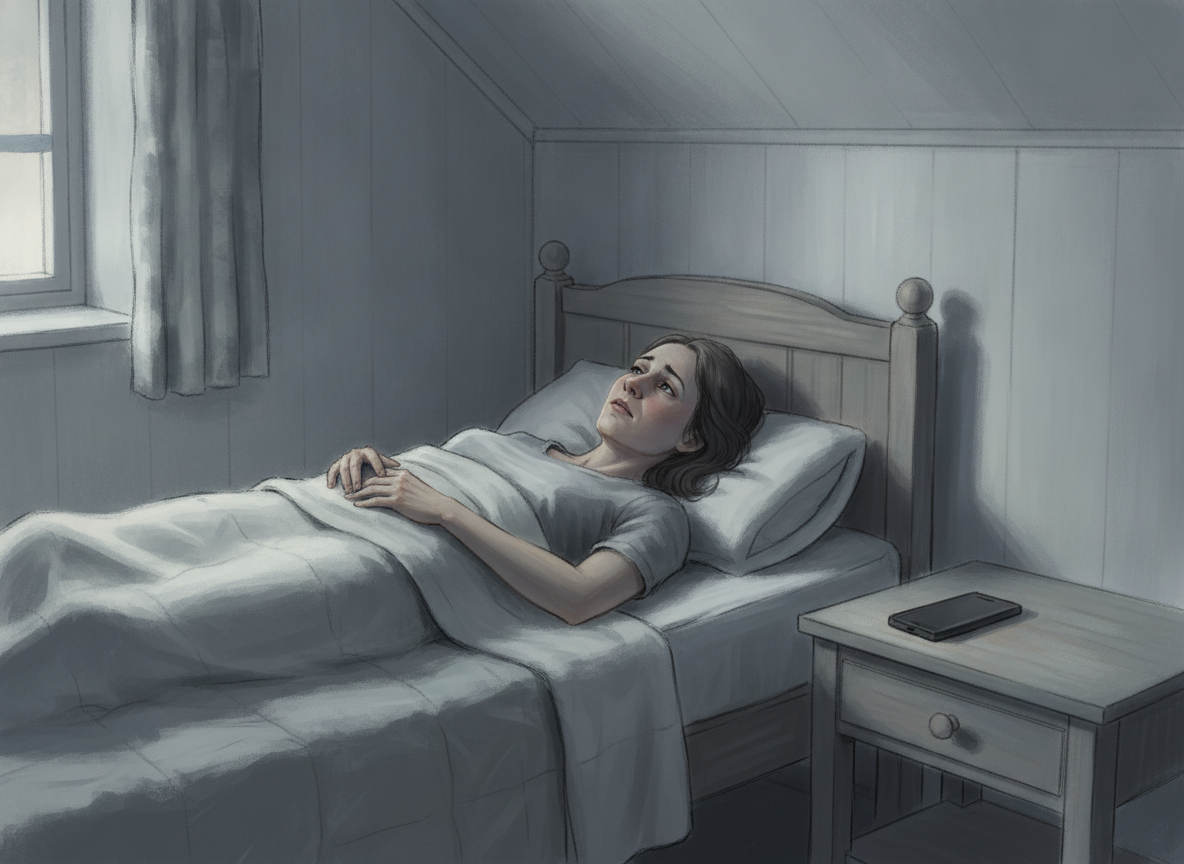
The morning did not arrive with the gentle persuasion Zoe remembered from old holidays, but with a stark, silver light that bleached the colour from the small cottage bedroom. For a moment, suspended between a dream of missed deadlines and the unfamiliar ceiling, she didn't know where she was. Then it returned, not in a rush, but as a slow, creeping tide: the drive, the exhaustion, the quiet rebellion that had landed her here. Seabrook.
Her phone, lying on the bedside table where she’d dropped it, was a black mirror reflecting the grey light. It was her only link to the life she had detonated, a phantom limb that still buzzed with remembered urgency. As if summoned by the thought, it vibrated, a low, insistent hum against the wood. A cascade of notifications lit up the screen. Emails, calendar alerts, a dozen missed calls from her director, Mark. Each one was a tiny, digital shackle. Her first instinct, ingrained by two decades of corporate conditioning, was to snatch it up, to formulate an excuse, to manage the crisis.
But she didn't. She watched the screen go dark, her heart hammering a frantic rhythm against her ribs. The silence that followed was broken only by the sound she was beginning to understand was the town’s true heartbeat: the slow, percussive crash of waves on the shore. It was a sound so immense, so indifferent, it made the panic feel small and ridiculous.
She swung her legs out of bed. The floorboards were cool beneath her bare feet. The clothes she’d packed in a frenzy were a stranger’s wardrobe: soft jumpers, worn denim, not a single piece of tailored wool or unforgiving silk among them. She pulled on a pair of jeans and a grey cashmere sweater that felt like a concession to comfort she hadn't earned. In the small kitchen, she found a tin of coffee and an old percolator. The process of making it was mechanical, a set of familiar motions that calmed the tremor in her hands. She drank it black, standing by the window that looked out onto a wild tangle of marram grass and, beyond it, the endless expanse of the sea.
The phone buzzed again in the other room. This time, the sound was a spur to action. She couldn't stay inside, a prisoner in her own sanctuary. She needed air. She needed space so vast it could swallow her anxiety whole.
Leaving the phone on the kitchen counter felt like cutting a vital cord, both terrifying and liberating. She pulled on a pair of walking boots she hadn’t worn in a decade and stepped outside. The air was sharp and clean, thick with the scent of salt and damp earth. A narrow, sandy path led from the cottage, winding through the dunes until it opened onto the beach.
The sheer scale of it stole her breath. A huge, sweeping crescent of pale sand stretched for miles in either direction, licked by the restless, grey-green water of the North Sea. The sky was a masterpiece of muted tones, a wash of pearl and slate that met the sea in a blurred, indistinct horizon. There was no one. Not a single soul. Just Zoe, the gulls crying high overhead, and the relentless rhythm of the tide.
She started walking, with no destination in mind, heading south where the sand seemed firmer near the water’s edge. Her boots made soft, satisfying crunches. At first, her mind was a whirlwind, a frantic slideshow of all the things she should be doing. The quarterly projections. The board presentation. The emails she was ignoring, each one breeding a dozen more in her absence. Her thoughts were a frantic, high-pitched static against the bass rumble of the ocean. She walked faster, as if she could outpace the noise in her head.
But the beach had its own agenda. The wind tugged at her hair, whipping it across her face, forcing her to focus on the simple act of putting one foot in front of the other. The constant, thunderous shush of the waves began to work on her, not silencing the static but absorbing it, drawing it out of her until it was just another sound in the vast, elemental orchestra. She walked for what felt like an hour, her pace gradually slowing as the tension in her shoulders began to unclench.
She looked back and saw her footprints trailing behind her, a temporary, meandering scar on the otherwise perfect sand. They looked lonely, singular. And for the first time, she felt it: the thing she’d been running towards without even knowing its name. Insignificance. In her life in the city, she was Zoe Pascale, Senior Partner, a name that carried weight, that unlocked doors and commanded attention. Her importance was a cloak she wore, heavy and constricting. Here, on this immense stretch of coastline, she was nothing. A tiny, fleeting speck against the backdrop of geological time. Her meticulously constructed career, her anxieties, her failures—the ocean didn't care. The tide would come in and wash away her footprints without a thought. And the release of that, the sudden, shocking permission to simply be, was so profound it made her want to weep.
Her aimless wandering eventually brought her to a set of weathered wooden steps leading up from the beach. Curiosity piqued, she climbed them and found herself at the edge of the town proper. Seabrook’s main street was a quiet, unassuming affair. A row of sturdy, stone-built cottages and storefronts faced the sea, their paintwork faded and blasted by the salt-laced wind. There was a small grocery, a pub with a sign swinging in the breeze, and a bakery whose warm, yeasty smell cut through the salty air. It was the antithesis of the gleaming steel and glass canyons she called home. It was slow. It was real.
Her eyes were drawn to a shop on the far side of the street. It had a simple, elegant sign carved from a single piece of weathered wood: TIDEWOOD GALLERY. The large window wasn't cluttered with merchandise but showcased one stunning piece: a long, low coffee table made from a gnarled piece of driftwood, its surface polished to a silken sheen, revealing a grain that swirled like a captive eddy of water. It was beautiful—organic and sophisticated all at once. Compelled by an impulse she didn't try to analyse, Zoe crossed the street and pushed open the heavy wooden door.
A small bell chimed softly, a delicate sound that was immediately absorbed by the profound quiet within. The gallery was one long, light-filled room. The air smelled of beeswax, dried lavender, and the clean, sharp scent of cut wood. It was a space designed for contemplation. Sculptures and furniture were arranged with generous space between them, each piece a testament to the raw beauty of wood. There were smooth, tactile bowls that begged to be held, intricate wall hangings made of interlocking pieces of reclaimed timber, and elegant, sweeping chairs that seemed to have grown right out of the floor. Everything spoke of patience, of a deep respect for the material. It was the calmest place Zoe had been in years.
She drifted through the space, running a hesitant finger over the satiny surface of a sculpture that mimicked the curve of a breaking wave. For the first time all day, her mind was quiet, focused only on the beauty in front of her. She felt observed, but not in an intrusive way. It was more a sense of a gentle, waiting presence.
“That one’s made from a piece of old sea defence. From the storm of ‘08.”
The voice was calm and low, with a warm, gravelly timbre that seemed to fit the space perfectly. Zoe turned. A man had emerged from a doorway at the back of the gallery, which she now saw led to a workshop. He was wiping his hands on a soft cloth, a few stray wood shavings clinging to the sleeve of his dark blue Henley shirt.
He was, she registered with a part of her brain that had been dormant for a long time, devastatingly handsome, but not in the sharp, predatory way of the men in her corporate world. This was a different kind of appeal. He looked to be in his mid-forties, with thick, dark hair lightly salted at the temples and a day’s worth of stubble on his jaw. But it was his eyes that held her. They were a warm, clear hazel, crinkled at the corners, and they held a look of such profound, settled calm that she felt her own internal chaos momentarily quieten. He wasn't assessing her, or sizing her up; he was simply seeing her.
“It’s beautiful,” she said, her voice sounding unnaturally stiff in the peaceful room. “All of it is.”
He smiled, a slow, easy smile that reached his eyes. “Thank you. The wood does most of the work. I just try to listen to what it wants to be.” He gestured with the cloth towards the piece she had been admiring. “That one fought me for a while. It had a few stories it wasn't ready to give up.”
Zoe found herself at a loss for words. It was such a strange, poetic way to talk about woodworking. The men she knew talked about acquisitions, market share, and returns on investment. They didn’t talk about listening to wood.
“I’m Leo,” he said, tucking the cloth into the back pocket of his worn jeans.
“Zoe.” The name felt naked without her surname and title attached.
“Welcome to Seabrook, Zoe.” His gaze was direct, yet gentle. “Just visiting?”
“Yes. Something like that.” She offered a tight, polite smile, the kind she used in boardrooms to deflect questions she didn’t want to answer. It was a shield, and she felt him register it as such, but he didn't press. He simply nodded, accepting her answer without judgment.
“It’s a good place for visiting,” he said. “Or for staying.”
An awkward silence stretched between them, but it wasn't uncomfortable. It was filled with the quiet presence of the gallery, the scent of the wood, and the distant murmur of the sea. Leo didn’t try to fill it with small talk or a sales pitch. He just stood there, patient and grounded, allowing her the space to simply be. It was a foreign and deeply unsettling feeling. She was used to interactions that were transactional, a rapid-fire exchange of information and intent. This was something else entirely.
She felt a sudden, urgent need to flee. This quiet, this man’s unnerving calm—it was too much, too soon. It held up a mirror to her own frantic, tightly-wound state, and she didn't like what she saw.
“I should… I should go,” she stammered, feeling like a fool. “I have things to…” Her voice trailed off. What things? She had nothing.
Leo’s expression didn’t change. There was no flicker of disappointment, only that same steady, kind understanding. “Of course. The door’s always open.”
She gave a curt nod and practically fled, the little bell chiming her retreat. Out on the street, the wind felt sharp again, and the sounds of the town seemed louder. She walked quickly, not looking back, her boots loud on the pavement. She didn't stop until she was back on the sandy path leading to the cottage, her heart thumping with an emotion she couldn't name.
It was only when she was back inside, the door safely closed behind her, that she allowed herself to breathe. Her phone lay on the counter, dark and silent. She looked at it, then at her own hands. They were trembling slightly. She thought of Leo’s hands, steady and capable, covered in a fine dust of the wood he shaped. She thought of his calm eyes and the quiet gallery that felt like a pocket of sanity in a mad world. The encounter had lasted no more than five minutes, but it had unsettled her more than a day of ignored emails and frantic calls. It had offered a glimpse of a different way of being, a quietness she craved but was terrified she could never possess.
Walking to the window, she watched the grey waves roll in, one after another, in their endless, patient cycle. For the first time since she’d arrived, she wasn’t just looking at the sea. She was thinking of the man who listened to the stories held in the wood it cast ashore.
Chapter 3 · The Language of the Tides
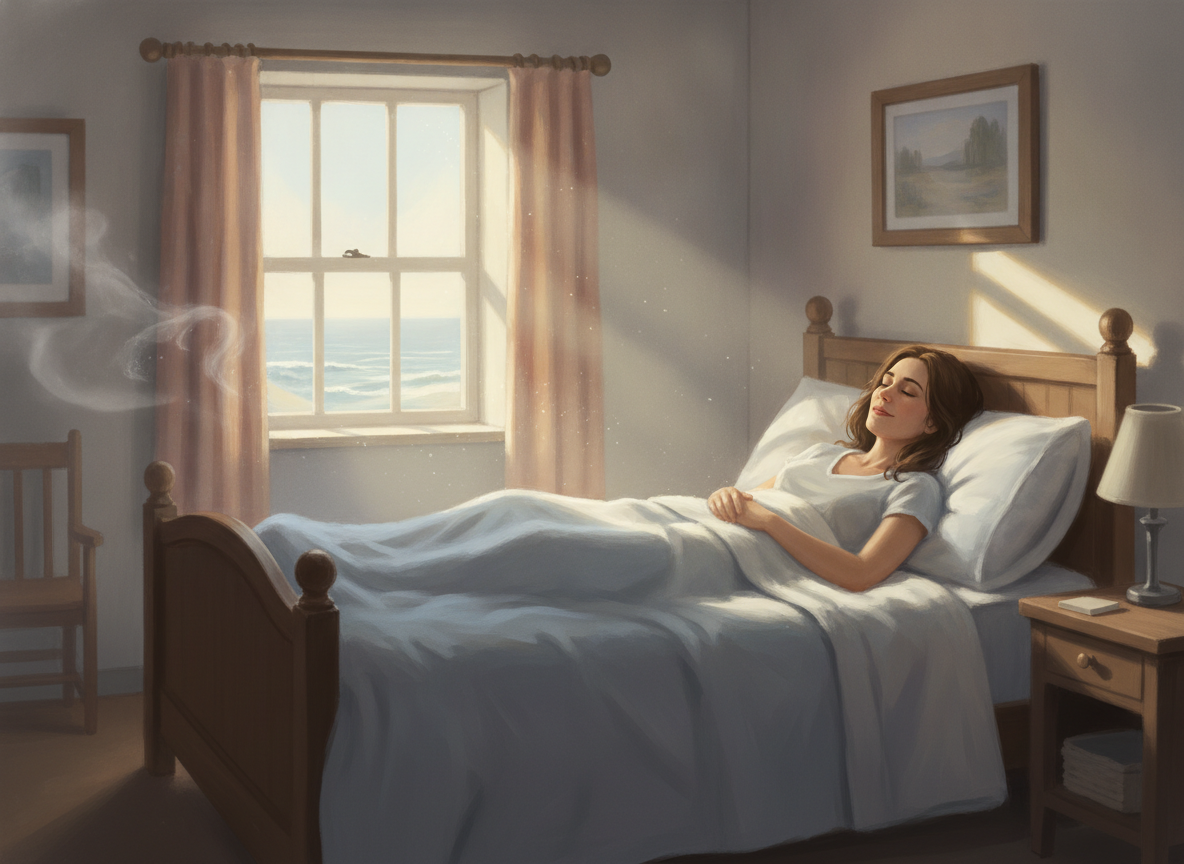
The sound of the sea had woven itself into the fabric of her sleep. Not the intrusive, demanding shriek of an alarm clock, but a vast, rhythmic breathing that seemed to sync with her own. Zoe woke to it, the low rumble of a wave collapsing on the shore a gentle persuasion to open her eyes. In the pale morning light filtering through the cottage window, the anxieties of her old life felt distant, like a broadcast from another country, its signal weak and distorted by static. The urge to fill the silence, to check emails, to create a to-do list, was still there—a phantom limb of her corporate self—but for the first time in years, another impulse felt stronger: the simple, quiet pull of the ocean.
She dressed in jeans and a soft, grey sweater, fabrics that felt alien and luxurious after years encased in structured blazers and silk blouses. Outside, the air was cool and carried the clean, briny scent of salt and damp sand. The sky was a watercolour wash of soft pinks and blues, a canvas of infinite calm that made the rigid lines of her former world seem absurd. She walked towards the water’s edge, her boots sinking slightly into the wet sand left behind by the retreating tide. The beach was a long, deserted curve of silver, littered with the sea’s offerings: tangled skeins of seaweed, the pearlescent interiors of broken shells, and smooth, grey stones that had been tumbled into perfection by the ceaseless water.
For a while, she simply walked, her mind blissfully empty, her focus narrowed to the repetitive crunch of her steps and the hypnotic rush and retreat of the foam at her feet. It was a meditation of motion, a stripping away of complexity until all that remained was the sky, the sand, and the sea. Then, further down the beach where the curve of the cove met a jumble of dark, mossy rocks, she saw him.
It was Leo, from the gallery. He was sitting on a massive piece of driftwood, bleached bone-white by the sun and salt, his back partially to her. He was utterly still, a sketchbook resting on his knees, his head bent in concentration. He seemed less a visitor to the landscape and more an integral part of it, as permanent and grounded as the rocks he sat amongst. A part of her, the efficient, time-is-money Zoe, wanted to turn back, to avoid the potential awkwardness of a second encounter. But a deeper, neglected part, the part that had driven her here in the first place, was curious. It was a curiosity untethered to any professional goal, a simple, human wanting-to-know that she realised she hadn’t felt in a very long time.
She slowed her pace as she drew nearer, not wanting to startle him. But the ocean was a noisy companion, and the scuff of her boot on a patch of pebbles was enough to make him look up. A slow smile spread across his face, reaching his eyes and erasing any concern she’d had about intruding. They were kind eyes, she noted again, the colour of sea-weathered slate, crinkled at the corners by sun and laughter.
“Good morning,” he called, his voice warm and easy, carried on the breeze. “The gallery owner, right?”
Zoe felt a faint flush of surprise that he remembered her. “Zoe,” she supplied, offering a small smile of her own as she stopped a respectful distance away. “And you’re Leo. I hope I’m not interrupting.”
“Never.” He closed the sketchbook, though he kept a piece of charcoal pinched between his fingers. “Just trying to solve a puzzle.”
“A puzzle?”
He patted the log beside him in a clear invitation. After a moment’s hesitation, Zoe sat, tucking her hands into her pockets and feeling strangely like a teenager on a first date. The proximity to him was unnerving and pleasant in equal measure. He smelled faintly of sawdust, coffee, and the salt air.
“The water,” he explained, gesturing with his charcoal-dusted thumb towards the waves. “I can carve the shape of a wave into wood. I can get the curve, the crest, the foam. But the movement… the feeling of it… that’s the puzzle. Trying to capture something that never holds still.”
Zoe looked from his thoughtful face to the endless motion of the sea. She had only ever seen the ocean as a view, a backdrop for a vacation. She’d never considered it a problem to be solved, or a subject to be understood. “I’ve never thought of it that way.”
“Most people don’t,” he said without a hint of judgment. “What brings you out so early?”
“I could ask you the same thing.” The deflection was automatic, a verbal feint she’d perfected in a thousand boardrooms.
He chuckled, a low, pleasant sound. “This is my version of reading the morning paper. The tide tells you what it left behind overnight. The light tells you what kind of day it’s going to be. It’s a different language, but you learn to pick it up.” He looked at her then, his gaze direct but gentle. “So. What brings you to Seabrook? Taking some time away from the city?”
There it was. The simple, direct question she had been dreading. The truth felt enormous and shameful, a confession of failure. I broke. I ran away. I abandoned a life I spent two decades building because I couldn’t stand another minute of it. But the words caught in her throat, choked by years of practiced composure.
“Something like that,” she said, the words carefully neutral. “I needed a change of scenery. My work is… intense.”
“What is it you do?” he asked, his curiosity seeming genuine.
“I’m a consultant,” she said, falling back on the familiar script. “I streamline operational logistics for multinational corporations. Mostly efficiency analysis and implementation strategies.” The jargon felt like armour, technical and impersonal. It explained everything and revealed nothing. She spoke of process maps, of stakeholder alignment, of quarterly growth targets, hearing her own voice as if from a great distance. It was the voice of a competent, confident professional she no longer recognised.
Leo listened patiently, his head tilted slightly, his gaze never leaving her face. He didn't interrupt. When she finally ran out of corporate-speak, the sound of the waves rushed back in to fill the silence. She felt a fool, as if she’d just tried to explain the colour blue to a blind man.
He didn’t comment on her work. Instead, he reopened his sketchbook. “See this line here?” he said, pointing to a sweeping charcoal arc. “That’s the high tide mark from yesterday. And this one, further down, is from the day before. The sea is breathing. Slow, deep breaths. Some days it’s agitated, choppy. Other days, like today, it’s calm. It has moods, same as any of us.”
Zoe looked at the drawing. It wasn’t a photorealistic rendering of the beach, but a series of lines and smudges that captured a feeling—the pull of the water, the weight of the sky. It was an emotional transcript of the morning.
“You see things… differently,” she said, the observation quiet, almost a whisper.
“I used to see things your way,” he said, surprising her. “I worked in finance. In the city. Lived by the clock, by the market, by the numbers on a screen. I spoke that language for a long time.”
Zoe stared at him. She tried to picture this man—this calm, centred artisan with charcoal on his hands—in a suit, barking orders into a phone. The image wouldn’t resolve. “What happened?”
He gave a small shrug, his eyes on the horizon. “One day I realised I was spending my life managing abstract numbers that had no weight, no texture, no soul. I was good at it, but it was starving me. So I quit. Came here. Learned a new language.” He tapped the cover of his sketchbook. “This one. The language of wood grain, and tides, and the way the light falls on the water in the late afternoon. It’s a much quieter language. And a lot more honest.”
His words landed like stones in the placid pool of her denial. He had just articulated the very core of her own crisis, but with a clarity and acceptance she was nowhere near achieving. He wasn’t ashamed of his escape; he framed it as a deliberate act of translation, of choosing a better story for his life.
A powerful current of attraction moved through her, sharp and unexpected. It wasn’t just that he was handsome in a rugged, unassuming way—the strong line of his jaw, the breadth of his shoulders under his worn jacket. It was his stillness. His quiet confidence was a force, a gravity that seemed to pull all the scattered, frantic pieces of her own psyche into a single, quiet orbit. And it terrified her. His peace was a mirror reflecting her own inner chaos, a stark reminder of everything she had lost, or perhaps had never truly possessed. To be near him was to be acutely aware of her own tightly coiled tension, the emotional armour she’d worn for so long she’d forgotten how to take it off.
She felt a sudden, desperate urge to tell him. To say, Me too. I’m starving, too. But the habit of a lifetime, the relentless discipline of keeping her vulnerabilities locked away, was a fortress. The drawbridge was rusted shut.
“That must have been… a difficult transition,” she managed, the words sounding stilted and inadequate to her own ears.
Leo looked at her, and for a fleeting moment, she felt completely, utterly seen. It was as if he could see past the consultant and glimpse the exhausted woman huddled inside.
“The hardest part,” he said softly, “is giving yourself permission to feel what you’re actually feeling. Not what you think you should be feeling.” He closed his sketchbook and stood up, brushing the sand from his jeans. “I have to go and open the gallery. The town runs on coffee and craftsmanship, and I provide one of the two.”
Zoe stood as well, feeling a sudden pang of loss, not wanting the conversation to end. “Thank you,” she said, not entirely sure what she was thanking him for. The conversation, perhaps. Or the brief, startling moment of clarity.
“Anytime.” His smile was back, easy and genuine. He paused for a second, as if considering his next words. “The light on the water changes completely in the evenings. Casts long shadows. It’s a different mood entirely. If you’re ever walking this way again around sunset, you’ll see what I mean.”
It wasn’t a question, or a direct invitation, but it felt like an open door. An offering. He gave her a small nod, then turned and began walking back towards the path to the town, his sketchbook tucked under his arm.
Zoe remained on the beach, watching him go until he was just a figure in the distance. She turned back to the ocean, but she saw it differently now. It wasn’t just a view anymore. It was a presence, a force with a rhythm and a voice. Leo had given her a single word in its language, and for the first time since she’d arrived, she felt a flicker of hope that she might, one day, learn how to speak it too.
Chapter 4 · The Grain of the Wood
The ghost in the machine lived in her work phone. It sat on the polished surface of the cottage’s small dining table, a sleek black rectangle against the warm pine, humming with a life she had fled. Each silent, screen-lit pulse was a summons from a world she no longer knew how to belong to, a world of metrics and deliverables, of stakeholders and escalations. Her personal phone was off, tucked away in her purse, but this one—the corporate one—was the true tether. It was the electronic leash that had kept her pacing the confines of a life that was slowly starving her.
For two days, she had ignored it. She had walked the beach, she had wandered the town, she had met Leo. She had breathed air that didn’t taste of recycled ambition. But the phone’s presence was a constant, low-grade fever in the quiet cottage. It represented a choice she hadn’t fully made. Leaving was an impulse; staying away required intention.
Her thumb hovered over the screen, muscle memory a potent force. She could check. Just a quick glance. Assure herself the company hadn’t imploded in her absence. Reassure herself that she was, in fact, indispensable, a validation she had chased for two decades. The thought was a familiar, addictive poison.
Outside, a wave crashed against the shore with a percussive roar, a sound so immense and final it seemed to shake the very foundations of the small house. It was a sound that had no agenda. It simply was. Zoe looked from the phone to the window, where the morning light was turning the sea from pewter to a soft, hazy blue. The phone demanded an answer. The sea demanded nothing.
With a resolve that felt foreign and fragile, she picked up the device. Her finger didn't swipe to unlock. It pressed and held the button on the side until the screen offered her the option to power down. The icon was a surrender. A victory. She slid her finger across the glass and watched the vibrant display collapse into darkness. The ghost was exorcised. For now. She opened a drawer in the small wooden dresser, placed the phone inside next to a spare set of linen, and closed it. The click of the drawer shutting was louder, more definitive, than the roar of the ocean.
She was going back to the gallery. The decision formed with the same quiet certainty as the one she had just made about the phone. It wasn't just about the beautiful objects within it, or even about the man who made them. It was about the feeling the place had given her—a sense of peace that was as solid and real as the wood itself. She wanted to feel it again.
The walk into town felt different this time. Her senses, no longer dulled by the background hum of digital anxiety, seemed sharper. She noticed the way the salt air had sculpted the shingles on the seaside cottages, curling their edges like dried leaves. She saw the intricate, fractal patterns of lichen on a stone wall, a slow, patient art that had taken decades to create. She was moving at Seabrook’s pace now, and the world was revealing details she had previously been too frantic to see.
The small bell above the Tidewood Gallery’s door announced her arrival with a cheerful, melodic chime. The scent of cedar and beeswax washed over her, a clean, grounding aroma that felt like coming home to a place she’d never been. Leo was behind the counter, sanding a small, intricately carved seabird, his brow furrowed in concentration. He looked up as the bell rang, and his face broke into a slow, genuine smile that made his eyes crinkle at the corners. It was a smile that expected nothing.
“You came back,” he said. It wasn’t a question.
“I did,” Zoe confirmed, her own voice sounding softer than she was used to. “I keep thinking about that table with the blue resin.”
“The river table,” he nodded, setting the bird down carefully on a soft cloth. “She’s a popular one. People are drawn to the way the light catches the blue. It’s like having a piece of the coast right in your home.”
“It’s beautiful,” she said, and the word felt inadequate. She ran a hand over a smooth, polished bowl on a nearby pedestal. The wood was warm, almost alive, beneath her fingertips. “Everything in here is.”
“Thank you.” He watched her for a moment, his gaze observant but not intrusive. It was the same calm, steady look he’d had on the beach, as if he could see past the tailored linen shirt and expensive watch to the frayed edges she kept so carefully hidden. “The gallery is the finished product, though. The real story happens in the back. Would you like to see the workshop?”
The offer was casual, but it felt significant. It was an invitation past the curated facade and into the place where things were made, where they were messy and unfinished. “I’d love that,” she said, surprised by her own eagerness.
He led her through a door behind the counter, and the scent of wood intensified tenfold. This was its source. The air was thick and fragrant with sawdust, with the sharp tang of cedar and the sweeter note of cherry. It was a cathedral of sawdust and light. Raw timber was stacked in neat piles against one wall, ranging from pale, creamy maple to a dark, chocolatey walnut. Tools of every shape and size hung in perfect order from a vast pegboard wall: saws and chisels, planes and clamps, each one worn with use but meticulously cared for. Sunlight streamed through a large, multi-paned window, illuminating millions of dancing dust motes, turning the air into a golden, swirling nebula.
In the center of the room stood a massive workbench, its surface scarred with the history of a thousand projects. On it lay a piece of wood unlike any Zoe had ever seen. It was gnarled and chaotic, a tempest of knots and swirling grain, with a jagged, unfinished edge where the bark still clung. It looked difficult, impossible even.
“This is where the magic, and the mistakes, happen,” Leo said, a note of deep affection in his voice as he surveyed the room. He gestured towards the workbench. “What do you see when you look at that?”
Zoe studied the piece of wood. “A challenge,” she said honestly. “It’s unruly. I wouldn’t even know where to begin.” In her world, a thing like that would be a problem to be solved, an obstacle to be straightened and sanitized. A variance to be eliminated from the dataset.
Leo smiled and picked it up, handling it with a familiarity that was both gentle and strong. “Most people say that. They see the flaws. But that’s not what I see.” He turned the piece over in his hands, his fingers tracing the chaotic lines of the grain. “This is a piece of claro walnut burl. A burl is a growth on a tree, usually formed after an injury or stress. It’s the tree’s response to trauma. The grain goes every which way because the tree is just trying to heal and survive, growing in whatever direction it can.”
He looked from the wood to her, and for a heart-stopping second, Zoe felt completely, utterly seen. As if he were talking about her.
“My job,” he continued, his voice soft, “isn’t to fight it. It’s not to force it to be a straight, perfect board. If I tried that, it would just splinter and break. My job is to listen to it. To follow the grain. To find the story it’s trying to tell, and then just… help it tell it. The beauty is already in there. All the chaos and the struggle, that’s what makes it beautiful.”
He set the burl down and picked up a different piece of wood from a nearby rack, a long, elegant plank with a perfectly straight, consistent grain. “Now this piece of ash, this wants to be a straight line. It wants to be a table leg, or a cabinet frame. It has strength and integrity in its structure. If I tried to force a deep curve into this, I’d have to steam it and bend it against its will. I’d be fighting its nature every step of the way.”
The words landed in Zoe’s chest like stones, heavy and true. Fighting its nature. Going against the grain. For twenty years, that had been her entire existence. She had been that piece of ash, and her career had been the steam, the pressure, the relentless force bending her into a shape she was never meant to hold. She had prized her ability to compartmentalize, to suppress, to push through. She called it discipline. Resilience. Professionalism. She saw it now for what it was: a slow, sustained act of violence against herself.
She thought of the promotions she’d chased, the brutal hours she’d worked, the way she’d tailored her personality to fit the sterile contours of a boardroom. She remembered the gnawing anxiety in her stomach before big presentations, an emotion she’d labelled as ‘excitement’ because anxiety was a weakness. She remembered the friendships that had withered from neglect, the hobbies she’d abandoned, the quiet, persistent inner voice she had systematically silenced until it was barely a whisper. She hadn't been living. She had been performing. And the performance had left her hollow.
“You have to honour the material,” Leo was saying, his passion for his craft making his voice resonate in the quiet space. “You can’t make walnut behave like oak. You can’t ask pine to do the work of mahogany. Each one has its own spirit, its own strengths. You just have to be quiet enough to see them.”
He moved over to a lathe in the corner, where a half-formed bowl was mounted. He picked up a chisel, his hand wrapping around the wooden handle with an easy confidence. “That’s what I left behind,” he said, not looking at her, but at the wood. “My old job. I was in finance. I was good at it. But I was forcing it. I was a piece of burl trying to be a two-by-four. Every day I had to shave a little piece of myself off to fit the mold. One day, I just realized there wasn’t going to be much left of me if I kept going.”
Zoe’s throat felt tight. He was narrating her life, translating her vague, suffocating sense of burnout into a language she could finally understand. It wasn’t just about being tired or overworked. It was a fundamental conflict of nature.
“So you came here,” she said, the words barely more than a whisper.
“So I came here,” he confirmed, finally turning to look at her again. His eyes were kind, holding no judgment, only a deep, quiet understanding. “And I started listening. To the wood. To the ocean. To myself, for the first time in a long time.”
He took a step closer, and the space between them seemed to charge with a gentle energy. He reached out, not to touch her, but to a stack of finished boards leaning against the wall. He ran his hand down the surface of one, a magnificent plank of tiger maple, its grain shimmering like a hologram.
“We spend so much of our lives trying to sand down our own knots, trying to hide the parts of our story that aren't straight and perfect,” he said, his gaze fixed on the wood but his words aimed directly at her heart. “But the knots are where the character is. They’re the record of the life that’s been lived.”
An unfamiliar prickling started behind Zoe’s eyes. For four decades, she had prided herself on her composure, her ability to remain unaffected, unflappable. Emotions were data points to be managed, not experiences to be felt. Now, standing in a dusty workshop that smelled of cedar and truth, her carefully constructed dam was beginning to crack. A single, honest feeling threatened to become a flood. She felt a desperate need to say something, to articulate the seismic shift happening within her, but the words wouldn’t come. Her vocabulary was full of corporate jargon, of deflections and evasions. She had no language for this.
Leo seemed to sense her turmoil. He didn’t press, didn’t ask the questions she could see forming in his eyes. Instead, he simply offered a quiet space for her to exist in her newfound silence. He turned back to his workbench, picking up the small seabird carving again, his presence a steady, grounding anchor in her internal storm.
After a moment that felt both fleeting and eternal, Zoe found her voice. “Thank you,” she said, and the two words carried the weight of everything she couldn't yet say. “For showing me this.”
“Anytime,” he said, his smile returning, softer this time. He gestured back towards the gallery door. “The ocean is putting on its evening show soon. The tide will be turning.”
The phrase hung in the air, laden with unspoken meaning. The tide will be turning. She felt it happening inside her, a slow, powerful, and terrifying reversal of a current that had pulled her out to sea for years. For the first time, she felt the possibility of being pulled back to shore.
Chapter 5 · An Interrupted Calm

The air in the workshop, thick with the scent of cedar and sawdust, seemed to hum with the energy of Zoe’s silent revelation. She stood amidst the curls of wood shavings, her hand still resting on the unfinished edge of a tabletop, the raw, honest grain a testament to a truth she had just unearthed within herself. For years, she had been sanding herself down, planing away her own inclinations, forcing her life into a shape it was never meant to hold. The thought was so immense, so fundamentally world-altering, that it left no room for words.
Leo watched her, his expression unreadable but for the quiet kindness in his eyes. He didn’t rush the silence, didn’t try to fill it with platitudes. He simply waited, giving her the space to inhabit the moment. He wiped his hands on a soft cloth, the gesture slow and deliberate.
“It’s a lot to take in,” he said finally, his voice a low, steady murmur that didn’t jar the quiet. “The wood. It has its own stories.”
Zoe finally looked up from the tabletop, her gaze meeting his. She felt strangely transparent, as if he could see the tectonic shift that had just occurred deep within her. She offered a small, wobbly smile. “I think I’ve been going against the grain for a very long time.” The admission was a feather-light whisper, yet it felt heavier than any corporate report she had ever delivered.
He nodded, a slow, understanding gesture. “Most of us have, at some point. The trick is noticing it before the whole thing splinters.” He leaned against his workbench, crossing his arms. The movement was casual, but it created an anchor in the room, a point of stability for her to focus on. “I’m about to close up for a bit. There’s a place down the street, The Salty Bean, that makes a decent cup of coffee. Nothing fancy. Would you… like to join me?”
The invitation was simple, unadorned with expectation. In her other life, an invitation like this would have been a calculation. A networking opportunity. A strategic alignment. Her mind would have raced through a dozen variables: her schedule, the potential benefit, the optics. But here, in the cedar-scented quiet of Seabrook, her response was startlingly simple.
“Yes,” she said, the word leaving her lips before the old, familiar hesitation could take root. “I’d like that very much.”
The walk to the café was a lesson in a different rhythm of life. Seabrook didn’t hurry. A few locals nodded to Leo as they passed, their greetings easy and unforced. The air, now free of the workshop’s dust, was crisp with salt and the faint, sweet smell of beach roses clinging to a nearby fence. Zoe found herself noticing the details: the way the afternoon sun cast long shadows down the narrow street, the colourful assortment of hand-painted buoys hanging by a shopkeeper’s door, the lazy caw of a gull circling overhead. For the first time in what felt like a decade, her mind wasn’t five steps ahead, planning the next move, anticipating the next problem. It was simply… here.
The Salty Bean was as unpretentious as Leo had promised. It was a small, cozy space with mismatched wooden tables, local art on the walls, and the rich, comforting aroma of roasted coffee and cinnamon. It was the antithesis of the sleek, minimalist chrome-and-glass coffee bars she frequented in the city, places designed for transactions, not conversations. Here, people lingered.
They found a small table by the window, which looked out onto the main street and, beyond it, a sliver of the deep blue sea. Leo ordered for them both—two black coffees—with the easy familiarity of a regular.
“So,” he began, once the steaming mugs were settled on the table between them, “aside from discovering the philosophical underpinnings of woodworking, how are you finding Seabrook?”
Zoe wrapped her hands around the warm ceramic, the heat a welcome anchor. “It’s… quiet.”
He chuckled, a warm, low sound. “That’s one word for it. Some people find the quiet deafening.”
“I think I needed it,” she confessed, surprising herself with the honesty. “The city is never quiet. There’s always a siren, or a deadline, or a… a buzzing. You don’t even notice it after a while. It just becomes the soundtrack to your life. Coming here, it’s like someone finally turned it off. At first, it was terrifying.”
“And now?” he prompted gently.
She considered the question, watching a woman across the street patiently untangle the leash of her very excited golden retriever. “Now, I’m not so sure. It’s still unsettling. But it’s a clean slate. An empty page.”
“Empty pages are the best kind,” he said. “They hold the most possibility.”
The conversation flowed with an ease that felt entirely foreign to her. They didn’t talk about work, not really. He told her about learning his craft from his grandfather, about the challenges of sourcing sustainable timber, and about the one time a seal had managed to get into his workshop and knock over a vat of varnish. She found herself laughing, a genuine, unburdened sound that felt rusty from disuse.
In turn, she shared things she hadn’t spoken of in years. Not the carefully curated anecdotes of her professional life, but small, forgotten pieces of herself. She told him about the summers she’d spent at her grandmother’s lakeside cottage as a child, learning the names of the constellations. She talked about a brief, ill-advised pottery class she’d taken in her twenties, admitting she’d been hopelessly bad at it but had loved the feeling of the clay spinning beneath her hands.
With every story shared, she felt a layer of her corporate armour flake away. The Zoe who managed multi-million-dollar accounts, who commanded boardrooms, who lived by the unforgiving rhythm of the fiscal quarter, began to recede. In her place sat a woman who remembered what it felt like to look at the stars, a woman who wasn’t afraid to admit she had failed at pottery. For a solid hour, she felt lighter than she had in years. She wasn’t a consultant or a problem-solver. She was just Zoe, having coffee with a kind-eyed man named Leo, with the sound of the ocean a distant, steady promise.
It was in the middle of one of his stories, something about the time he’d tried to repair the old fishing trawler down at the docks, that her personal phone, lying face down on the table, buzzed.
It was a single, sharp vibration, but it sliced through the calm atmosphere like a gunshot.
Instinct, honed by two decades of constant availability, took over. Her hand shot out and flipped the phone over. Her work phone was off, locked in a drawer back at the cottage, but she’d forgotten about the alerts she’d allowed to be pushed to her personal device. A just-in-case measure. An emergency override.
The name on the screen was Marcus Thorne. Her largest client. The CEO of a sprawling tech conglomerate whose account she had single-handedly landed and managed for the last three years. The notification was a calendar alert: Project Nightingale: Final Review Deck DUE. Followed by a text preview: Zoe, Abernathy is asking for the Nightingale projections. Said you were unreachable. Call me URGENT.
The words hit her like a physical blow. A jolt of pure, refined adrenaline shot through her veins, a chemical cocktail her body knew all too well. It was the feeling of a looming deadline, of a crisis in the making, of a fire she was expected to extinguish.
Instantly, the cafe disappeared. The scent of coffee, the warmth of the mug, the sound of Leo’s voice—it all faded into a dull, distant hum. Her focus narrowed to the glowing rectangle in her hand. Her spine straightened. Her shoulders, which had been relaxed just a moment before, drew up and tightened, bracing for impact. A subtle frown line appeared between her eyebrows, a crease so familiar it felt like it was etched into the bone.
She didn’t even realize she had stopped breathing.
Leo’s story trailed off. The shift in her was so absolute, so instantaneous, that it was as if a switch had been flipped, plunging the warm, easy space between them into a sudden chill. He didn’t need to see the screen to know what had happened. He had seen that look before, on the faces of colleagues in his own past life. It was the look of a person being summoned back to a reality they were trying to escape.
Zoe’s thumb hovered over the screen, her mind already spinning, calculating. Abernathy was impatient. Thorne was demanding. The Nightingale deck was a beast, ninety slides of complex data she knew better than anyone. Her deputy, Sarah, was capable, but she lacked the finesse for the executive summary. A mistake there could jeopardize the next phase of funding. Her mind was already in the boardroom, three states away, troubleshooting, delegating, strategizing.
“Zoe?”
Leo’s voice was quiet, but it managed to cut through the noise in her head. She looked up, her eyes struggling to refocus on him. She felt a flush of something—embarrassment? frustration?—at being caught, at having her carefully constructed peace so easily shattered.
“I’m sorry,” she said, her tone clipped and efficient. It was her work voice. “It’s just… something from the office.”
She made a move to stand, the impulse to find a quiet corner, to make the call, to fix the problem, nearly overwhelming her.
Leo didn’t move. He simply watched her, his gaze steady and filled not with judgment, but with a deep, disarming empathy. He didn’t ask what was wrong. He didn’t tell her to ignore it. He just held the space, his own calm a stark contrast to the storm that had just been unleashed inside her.
He took a slow sip of his coffee, then set the mug down with a soft click. He looked past her, out the window toward that sliver of blue.
“The ocean doesn't have deadlines,” he said, his voice soft and even. “It’s always there, when you need to remember how to breathe.”
His words landed with a quiet resonance, bypassing the frantic project manager in her brain and speaking directly to the woman who had, just moments ago, been talking about the stars. She felt utterly exposed, her inner turmoil laid bare on the table between them. Yet, beneath the exposure, there was a strange and unfamiliar flicker of warmth. He wasn't trying to fix her problem. He wasn't offering a solution. He was simply offering a truth, a reminder of the peace she had sought and so briefly found.
The urgency to call Thorne warred with the profound stillness of Leo’s gaze. The battle between the life she had built and the one she was tentatively exploring was being waged right there, in a small-town coffee shop, over a single text message. And for the first time, she wasn’t entirely sure which side she wanted to win.
Chapter 6 · The Stillness After the Storm

The air had turned thick and heavy by the time Zoe woke the next morning, the lingering taste of coffee and regret still on her tongue. Her conversation with Leo had been a small, sunlit clearing in a dense forest, but the ping of that single notification had plunged her back into the shadows. The sky outside her window seemed to sympathise; what had been a pale, hopeful blue was now bruised with shades of slate and charcoal. A restless wind began to whisper through the dune grass, its voice rising to a mournful sigh that seeped through the cottage walls.
She had planned to walk the beach again, perhaps to find some way to reset the delicate balance that had been established between her and Leo, a balance her own conditioning had shattered. But the weather had other ideas. The first fat drops of rain splattered against the glass like thrown pebbles. Within minutes, the sky opened. The world beyond Saltwood Cottage dissolved into a churning, grey chaos of wind and water. The soft shushing of the tide was replaced by the roar of a furious ocean, the waves crashing against the shore with a percussive violence that vibrated through the floorboards.
Zoe was trapped. Not just in the cottage, but inside her own head, a place she had spent decades expertly avoiding. Her usual armoury of distractions was useless here. There were no spreadsheets to analyse, no stakeholder reports to draft, no pointless meetings to fill the echoing silence. There was only the storm outside and the far more terrifying one gathering within.
She paced the small living area, from the window overlooking the maelstrom to the cold fireplace and back again. The cottage, her sanctuary, now felt like a cage. Every gust of wind that rattled the window frames seemed to shake something loose inside her. She replayed the moment in the coffee shop: the easy cadence of their conversation, the warmth in Leo’s eyes, the unfamiliar sensation of her own shoulders relaxing. Then, the electronic chime—a sound as innocuous as a bird call and yet as jarring as a gunshot. She had watched herself transform, the open, curious woman receding in an instant, replaced by the tense, guarded executive. She had seen the flicker of understanding—or was it disappointment?—in Leo’s eyes before he had so gently deflected. The ocean is always there to help you breathe.
But she couldn’t breathe. Not really. She was suffocating under the weight of an identity she had meticulously constructed, brick by heavy brick. Zoe, the problem solver. Zoe, the one who gets it done. Zoe, who never cracks. The praise she had chased her entire career now sounded like an epitaph. The storm howled, and Zoe finally allowed herself to hear the question beneath its fury: If you are not that person, who are you?
The fear that answered was cold and absolute. It was the terror of emptiness, of having poured every ounce of her being into a vessel that was not her own, only to find herself at forty-three with nothing left for herself. The client’s notification hadn’t just been a reminder of work; it had been a summons from her jailer. And she had, without a moment’s hesitation, stood up and rattled the bars of her own cell.
She sank onto the sofa, wrapping her arms around herself as a violent gust of wind hit the cottage with the force of a physical blow. The sound tore something open inside her. A sob clawed its way up her throat, raw and ragged. It was followed by another, and then another. The tightly controlled dam she had maintained for twenty years finally broke. The tears were not just for her exhaustion or her loneliness; they were a flood of grief for the woman she might have been—the one who laughed easily, who loved art, who knew how to sit in a quiet room without feeling the desperate urge to produce, to achieve, to justify her own existence. She wept for the lost years, for the ignored whispers of her own heart, until she was empty, boneless, and utterly spent, curled on the sofa with the storm raging as her only witness.
She slept, a deep and dreamless sleep, lulled by the tempest’s eventual retreat. When she woke, it was to a world remade. Silence. A profound, crystalline silence broken only by the drip of water from the eaves and the distant, gentled rhythm of the waves. She pushed herself up, her body aching as if from a fever, and went to the window.
The sky was washed clean, a pale, delicate blue. The rising sun cast a soft, golden light over a landscape that was glistening and renewed. The air that drifted through the cracked-open window was sharp and clean, smelling of salt, wet earth, and ozone. A sense of peace settled over her, as calm and deep as the stillness after the storm. The emotional gale had passed through her, and while the wreckage was still there, the suffocating pressure was gone. She felt… quiet.
A pull, primal and insistent, drew her outside. She pulled on boots and a thick sweater and walked out onto the damp sand. The beach was almost unrecognisable. The tide had receded, leaving behind a chaotic tapestry of treasures and debris. Ribbons of dark green seaweed lay in tangled masses, dotted with the pearlescent interiors of broken shells. And everywhere, there was wood. Gnarled roots, smooth, pale branches, and dark, heavy logs were strewn across the shore, a testament to the ocean’s immense power.
She walked towards the small cluster of buildings that made up the town, her boots making firm impressions in the sand. As she neared the Tidewood Gallery, she saw him. Leo was on the beach just behind his workshop, his back to her. He was methodically clearing a path through the debris, his movements unhurried and efficient. He would bend, assess a piece of driftwood, and then with a smooth economy of motion, haul it to a growing pile near the dunes. There was no strain in his posture, only a quiet, steady strength that seemed to be in perfect conversation with the task at hand.
He must have sensed her presence, because he straightened and turned. His eyes met hers across the sand, and he offered a small, calm nod of greeting. There was no surprise in his expression, no awkward questions about where she’d been. It was a simple, profound acceptance of her being there.
Zoe didn't know what to say. The usual currency of her world—clever conversation, witty remarks, strategic questions—felt utterly alien on this clean-swept beach. So she said nothing. She simply walked towards him, and as she got closer, she bent down, picked up a wave-smoothed piece of cedar, and carried it over to his pile.
And so they worked. For what might have been an hour or more, they moved in a shared, unspoken rhythm. Leo handled the larger, heavier pieces, his muscles working beneath his worn flannel shirt. Zoe gathered the smaller branches, her hands growing raw and sandy, her mind blissfully empty. The only sounds were the cawing of the gulls overhead, the sighing of the surf, and the gentle scrape of wood against sand.
This silence was different from the suffocating quiet of the cottage. It was a living thing, a space filled not with anxiety, but with mutual effort and a deep, grounding sense of purpose. It was a form of communication more honest than any words she could have spoken. In their shared labour, she was saying, I am here. I am present. And his quiet acceptance was saying, I see you.
She watched his hands as he examined a particularly twisted piece of oak, his fingers tracing the grain with a familiar reverence. He saw the story in it, she knew. He wasn't just clearing debris; he was salvaging potential. The thought resonated so deeply it almost made her stumble. For the first time in her life, she felt useful in a way that didn’t deplete her. It was a simple, physical act that was slowly, piece by piece, helping to clear a path not just on the beach, but inside her own soul.
Finally, the main stretch of sand behind the gallery was clear. They stood side by side, looking at the impressive pile of salvaged wood. Her muscles hummed with a pleasant fatigue, and a light sweat cooled her brow.
"Thank you," Leo said, his voice quiet, not breaking the spell of the morning.
"It was good to do something," she replied, the words feeling inadequate but true.
He nodded, his gaze moving from the cleared path to the pile of wood, then back to her. His kind eyes held a new depth, a knowing gentleness that saw past the consultant and straight into the weary woman who had weathered her own storm.
"The ocean always gives something back after it takes," he said softly, gesturing to the pile. "You just have to be willing to see the new shape of things." He looked directly at her then, a small, hopeful smile touching his lips, and in his gaze, she felt the unmistakable possibility of a new beginning.
Chapter 7 · Truths at Sunset

The call came mid-afternoon, as Zoe was tracing the whorls in a piece of sea-smoothed driftwood she’d brought back to the cottage. It was Leo, his voice a warm, steady hum over the line, a stark contrast to the frantic, clipped tones she was used to. He said the sky was clearing in a way that promised a spectacular sunset, and that it felt like a shame to waste it. He wondered if she might join him for a simple dinner on the beach. Not a date, he’d clarified quickly, just two people sharing a good view.
The careful framing of his invitation, the gentle lack of pressure, was precisely what made her say yes.
He picked her up an hour later, the interior of his old truck smelling faintly of sawdust and sea salt. In the back was a wicker basket and a thick, woollen blanket. He drove them not to the main stretch of sand she had come to know, but down a winding lane that ended near a tumble of grassy dunes. A narrow, sandy track led through them, and as they emerged on the other side, the view made Zoe’s breath catch.
They were in a small cove, sheltered on three sides by dark, dramatic cliffs. The sand here was finer, paler, and the waves hushed as they rolled onto the shore. And they were utterly alone. It felt like a secret, a place tucked away from the world.
“This is beautiful, Leo,” she said, her voice softer than usual.
“It’s my favourite spot,” he replied, spreading the blanket over a flat expanse of sand well above the tide line. “The acoustics are perfect. All you can hear is the water.”
He was right. The sound was purer here, a rhythmic, meditative whisper that seemed to quiet the lingering static in her mind. They worked in a comfortable silence, unpacking the basket. It was nothing elaborate—a crusty loaf of bread, a wedge of sharp cheese, a container of olives, and a flask of what turned out to be hot, spiced apple cider. It was simple, perfect.
As they ate, the sun began its descent, bleeding gold and rose across the horizon. The light softened everything, erasing hard edges and bathing the cove in a warm, ethereal glow. It was a beauty so profound it felt almost sacred, and for a long while, they just watched, content to be silent witnesses.
It was Leo who finally spoke, his gaze fixed on the point where the sun touched the sea. “This is what I missed the most when I lived in the city,” he said, his voice thoughtful. “The sense of an ending. A real one. In the office, days just bled into nights and then back into days. There was no punctuation.”
Zoe knew that feeling intimately. The endless loop of deadlines and demands, the tyranny of the blinking cursor on a screen at two in the morning. “You were in the city, then? Before Seabrook?”
He nodded, turning to look at her. The sunset cast his kind eyes in shadow, but she could feel their steady focus. “For fifteen years. I was an architect. Big firm, big projects, bigger stress.” He gave a small, self-deprecating laugh. “I was good at it. Climbed the ladder, got the corner office, the whole thing. I had a life that looked incredibly successful from the outside.”
“And on the inside?” Zoe asked, her voice barely a whisper.
Leo took a slow sip of his cider, considering. “On the inside, I was… hollowing out. It was a slow process, almost unnoticeable at first. I just kept pushing, telling myself the pressure was normal, that the anxiety was just the price of ambition. I stopped sleeping well. I was irritable. I’d look at these beautiful, complex blueprints I’d designed and feel absolutely nothing.”
He paused, tracing a line in the sand with his finger. “The breaking point was a panic attack. A big one. Happened right in the middle of a client presentation. My heart felt like it was going to explode out of my chest, I couldn't breathe. I thought I was having a heart attack. In that moment, staring at the concerned faces of a dozen board members, I realized I hadn't taken a full, deep breath in about five years.”
Zoe felt a cold knot tighten in her stomach. His story was echoing her own with a terrifying fidelity. The hollowness, the anxiety masquerading as ambition, the physical manifestation of a soul in revolt. She thought of her own breaking point, the sterile silence of her office after her team had gone home, the sudden, overwhelming wave of nausea as she stared at a project plan that represented months of her life and felt nothing but revulsion.
“What did you do?” she asked.
“I finished the presentation on autopilot,” he said with a wry smile. “Then I went to my office, packed up a box of personal things, and walked out. I never went back. Sold my apartment, bought the gallery space here—it was a derelict boat shed then—and started over. My parents thought I’d lost my mind. My colleagues… well, they called it a mid-life crisis.”
“And was it?”
“No,” he said, his voice clear and certain. “It was a mid-life correction. It was the sanest decision I ever made. I chose peace over prestige. It turns out, peace pays better, just not in dollars.” He looked out at the ocean, now a deep, shimmering violet under the fading light. “I had to learn a new language here. The language of the tides, the grain of the wood. The language of my own heart, mostly. I’d been ignoring it for so long I’d forgotten how to hear it.”
The language of my own heart. The phrase landed in Zoe’s chest with the weight of a stone. For decades, her heart’s language had been systematically translated into key performance indicators and strategic objectives. Its raw, emotional vocabulary had been edited down to a sterile corporate dialect. She had done the editing herself, meticulously, ruthlessly.
Leo’s story wasn’t just a story; it was a permission slip. It was a map of the very wilderness she was currently lost in, showing a way out that wasn’t failure, but a different kind of success. The air in her lungs felt thick with unspoken words. The truth of her own situation—the burnout, the flight from her life, the terror and the liberation of it all—rose in her throat, a desperate, surging tide.
This was the moment. He had created a space of such profound safety and understanding that she could finally, finally let go. She could tell him. She could say the words aloud and make them real.
“Leo, I…” she began, her voice cracking on the first word.
He turned his full attention to her, his expression open and patient. He waited. The entire world seemed to wait—the waves held their breath, the last sliver of sun paused on the horizon.
“I… I’m here because…”
The sentence hung in the air, unfinished. The old reflexes, honed over twenty years of boardroom battles and high-stakes negotiations, kicked in with the brutal efficiency of a trained guard dog. Don’t show weakness. Don’t expose your flank. Emotion is a liability. The familiar, cold voice of self-preservation slammed a door shut in her mind. The tide of confession receded as quickly as it had risen, leaving her feeling empty and washed out.
She looked away from his gentle, waiting eyes, fixing her gaze on a distant wave. “Because I needed a vacation,” she finished, the lie tasting like ash in her mouth. “My job is… very demanding. I just needed to recharge my batteries.”
The words were a betrayal of the moment, of the truth he had so generously offered her. The silence that followed was not awkward, but it was heavy with what had not been said. Zoe could feel the heat of a blush creep up her neck.
Leo didn’t call her on it. He didn’t push or question. He simply nodded, a flicker of something—disappointment, perhaps, or just gentle understanding—passing through his eyes before it was gone. He reached for the loaf of bread, broke off a piece, and held it out to her.
“Well,” he said, his voice still warm, still kind. “Seabrook is a good place to recharge.”
The simple, graceful acceptance of her retreat was somehow more piercing than any interrogation could have been. He had seen her, right up to the edge of her truth, and he had watched her step back. And he was letting her.
As darkness finally settled, they packed up the basket and walked back along the sand. The stars were beginning to appear, sharp and brilliant in the clear, clean air. Near the path back to the truck, Leo stopped and touched her arm lightly, bringing her to a halt.
“Zoe,” he said, his voice low in the quiet of the cove. “Whatever your reasons for being here… I’m glad you are.”
His hand lingered on her arm for a moment longer than necessary, a small point of warmth against her skin, before he let it fall away. He had offered her a bridge, and she had refused to cross it. But as they walked the rest of the way in silence, she couldn’t shake the feeling that he was perfectly willing to wait on the other side.
Chapter 8 · The Turning Point

A profound sense of peace had settled in Zoe’s bones, as soft and persistent as the sea mist that clung to the cliffs in the early morning. It was the afterglow of the picnic with Leo, of the shared vulnerability under a sky bleeding with colour. The truth of his past, offered so freely, had created a space for her own to breathe, even if she hadn't yet found the words for it. Walking along the tideline now, the cool water lapping at her ankles, she felt a quiet integration, as if the jagged edges of her city self were slowly being worn smooth by the relentless gentleness of the sea. For the first time in what felt like a lifetime, she wasn't planning her next move or analysing a future outcome. She was simply here.
The shrill, electronic chime of her personal phone was a physical shock, a shard of glass in the soft quiet. She flinched, her heart lurching with an old, familiar Pavlovian dread. For three weeks, this phone had been a lifeline only to her sister, a camera for beach sunsets. Now, the name glowing on the screen felt like an indictment: DAVID STERN.
Her thumb trembled as she answered. “Zoe.”
“Thank God,” David’s voice crackled through the speaker, a frantic torrent of panicked energy that immediately dissolved the peace around her. “Where the hell have you been? Your work phone’s been off for weeks. I’ve been leaving messages.”
“I’ve been…away,” she said, the word sounding flimsy and inadequate.
“Away isn’t going to cut it. It’s OmniCorp. They’re walking. The whole deal, the one you spent six months building, is about to go up in smoke. They’re citing a material breach in the preliminary agreement. Patterson is fielding calls from their GC, and he’s getting slaughtered. It’s a complete disaster.”
Zoe’s mind, without her permission, began to click and whir, the rusty gears of her corporate persona grinding back to life. OmniCorp. The Anderson Clause. Section 4b. She could feel the mental pathways lighting up, the old armor assembling itself around her heart. “What’s the specific point of contention?” she asked, her voice already shifting, becoming crisper, more detached.
“Who the hell knows? That’s why I’m calling you. You’re the only one they’ll listen to. You’re the only one who can fix this. I need you on the first flight back tomorrow morning. 7 a.m. out of Portland. A car will meet you at the airport. The team is meeting at noon. I need you here, Zoe. I need you to fix this.”
He wasn’t asking. He was commanding. And the most terrifying part was the deeply ingrained instinct that rose up to meet his demand. The part of her that thrived on crisis, that equated her value with her ability to extinguish fires. The part that had been running her life for two decades.
The sea breeze felt cold on her skin now. The sound of the waves was no longer a comfort, but a distant, irrelevant noise. “Okay,” she heard herself say, the word tasting of ash. “I’ll be there.”
“Good. I knew I could count on you.” He hung up.
Zoe stood frozen, the phone still pressed to her ear. The world had tilted back onto its old, agonizing axis. The last three weeks evaporated like sea foam on hot sand, leaving behind only the stark reality of what she was: a problem solver, a fixer, a tool to be deployed. The logistics were already spooling through her mind. Call a taxi for 4 a.m. Pack. Set three different alarms. The grey suit hanging in the back of her closet in the city. The hard, sensible shoes. The weight of her laptop bag. A hollow ache bloomed in her chest, vast and empty.
She had to tell Leo.
She found him in his workshop, the door wide open to the afternoon sun. The air inside was rich with the scent of cedar and salt, a smell she was beginning to associate with a sense of calm. He was planing a long, slender piece of driftwood, his movements economical and fluid. He looked up as her shadow fell across the threshold, and a slow, easy smile lit his features, a smile that faltered when he saw her face.
“Zoe? What is it?”
She leaned against the doorframe, feeling strangely disconnected from her own body. “I have to go back,” she said, the words flat. “To the city.”
He put the plane down carefully on his workbench and wiped his hands on a soft cloth, his full attention on her. His gaze was steady, searching, but not intrusive. “Is everything alright?”
“It’s work. An emergency with a client. They need me.” I need you to fix this. The words echoed in her head. She had built her entire identity on being the one who was needed, the one who could fix it. Why did it suddenly feel like a cage?
“I see,” he said. His voice was quiet, stripped of the warmth it had held only moments before. She saw the disappointment in his eyes, a flicker of something that looked like loss, and it was a thousand times worse than any argument or plea would have been. He didn't try to stop her. He didn't ask her to stay. He just stood there, his presence a quiet testament to the life she was about to leave behind.
“I have to,” she repeated, more to herself than to him. “It’s my responsibility.”
He gave a slow nod, his expression unreadable now. “Of course,” he said, his voice low. “Work is work.” He looked away for a moment, out towards the shimmering line of the horizon visible from his door. Then his eyes met hers again, and they held a deep, unnerving clarity. “I just hope you make the choice that is truly best for you, Zoe.”
The words landed not as an opinion, but as a benediction. A gentle release. He wasn't telling her what to do; he was trusting her to know. It was a level of faith no one, least of all herself, had ever granted her before. It was terrifying.
Back at Saltwood Cottage, the open suitcase on the bed was a gaping maw. She moved with a brittle, robotic efficiency that felt like a betrayal of the slow, mindful person she had been becoming. She folded the soft cotton shirts, the worn-in jeans, the ridiculously comfortable linen trousers she’d bought at a shop in the village. Clothes for a life she was abandoning. Each garment felt like a small surrender.
Outside, the tide was coming in, a relentless shushing sound against the shore. It was the rhythm that had governed her days, lulling her to sleep at night and waking her in the morning. Now it sounded like a clock, ticking down the final hours of her freedom.
She sank onto the edge of the bed, a lavender-coloured cashmere sweater clutched in her hand. It was soft and absurdly impractical, and she had worn it during the picnic with Leo. The faint scent of woodsmoke still clung to it.
I just hope you make the choice that is truly best for you.
Leo’s words weren’t an echo anymore; they were a living presence in the room. What was the choice that was best for her? Her mind presented the case with the ruthless logic of a prosecuting attorney. The best choice was to protect her career. To salvage the OmniCorp deal. To reaffirm her value to the firm and justify the sacrifices she had made. To return to the life she had meticulously constructed, the life that was safe in its soul-crushing familiarity. It was the only choice that made sense.
But her heart—an organ she had long treated as an unreliable and overly emotional junior associate—was staging a mutiny. It presented its own evidence. The feeling of the sun on her face during that first walk on the beach. The quiet satisfaction of her own hands, raw and aching, as she helped Leo clear driftwood after the storm. The taste of salt on her lips. The sound of his laughter. The astonishing, terrifying relief of watching him talk about his own brokenness and seeing not weakness, but a profound and beautiful strength.
She thought of her apartment in the city, a space so sterile and controlled it felt more like a showroom than a home. She pictured the view from her fortieth-floor office: a panorama of steel and glass, impressive and utterly devoid of life. She remembered the gnawing emptiness that settled in on Sunday nights, the physical effort it took to breathe on Monday mornings as she prepared for another week of battle.
That was the life she was packing for. A life of forcing herself against her own grain until she had almost splintered apart.
Leo hadn't run from his unraveling; he had followed it. He had listened to the desperate cry of his own spirit and it had led him here, to a life of intention and quiet joy. He had looked at her, truly looked at her, and seen someone worthy of that same journey. And she was about to throw it all away for a crisis that, in the grand scheme of the tides and the stars, meant absolutely nothing. A fire she was expected to put out, only so another one could be lit next week, and the week after that.
The frantic, anxious energy that had propelled her since David’s call finally dissipated. It drained out of her, leaving not a void, but a vast and silent space. A stillness. In that stillness, the truth rose, clear and undeniable.
Going back wasn’t an obligation. It was a choice.
She was choosing to put the armor back on. She was choosing the sterile office over the salt-laced air. She was choosing to sacrifice herself, all over again, on the altar of a career that had already taken everything and given her nothing real in return.
And for the first time in her forty-three years, she didn’t want to do it.
Her eyes fell on her phone, lying on the bedside table. The screen glowed softly, displaying the airline confirmation email. A digital ticket back to the cage. It was all so easy. One flight, and she could pretend the last three weeks had been nothing more than a pleasant dream. She could be Consultant Zoe again, formidable and competent and utterly, devastatingly hollow.
But she remembered the look in Leo's eyes. The quiet disappointment. The gentle hope. He hadn’t asked her to stay for him. He had asked her to choose for herself.
With a slow, deliberate breath that felt as if it drew the entire ocean into her lungs, Zoe reached for the phone. Her thumb, no longer trembling, moved across the screen. It wasn’t a frantic or emotional gesture. It was the calmest, most certain movement she had ever made. She found the link in the email, her finger hovering for a single, final beat over the button. Then she pressed it.
Your flight has been cancelled.
A wave of something akin to terror, but lighter, cleaner, washed through her. It was the terrifying, exhilarating vertigo of standing at the edge of a cliff, not about to fall, but about to fly. She had no plan. No strategy. She had just severed the primary cord to her old life with a single tap.
She stood up and walked to the large window of the cottage, looking out at the endless, darkening sea. The tide was high now, the waves cresting with a powerful, churning grace. They receded, and they returned. Always, they returned. She didn't know what she would say to David, or what she would do tomorrow, or the day after that. But as the first star appeared in the deepening twilight, she knew, with a certainty that settled deep in her soul, that she wasn't leaving. She was finally arriving.
Chapter 9 · The Unspoken, Said
The morning sky was a soft, bruised purple, the colour of a day that hadn’t yet decided its intentions. Zoe woke not to the shrill demand of an alarm clock but to the gentle insistence of light seeping through the curtains of Saltwood Cottage. For a moment, a phantom anxiety flickered through her—the frantic, pre-flight checklist, the mental map to the airport, the weight of her briefcase. Then it was gone, dissolved by the low, rhythmic sigh of the ocean. She was not on that plane. The knowledge didn’t land with a crash of triumph, but with a quiet, profound stillness that settled deep in her bones.
She dressed slowly, pulling on jeans and a soft woollen jumper, clothes that felt like an extension of herself rather than armour. The cottage, which had felt like a temporary shelter for weeks, now seemed to hold her with a different kind of embrace. It was no longer a place of escape, but the start of something else, something terrifyingly and wonderfully undefined. She made coffee, the ritual a small anchor in the vast sea of her new reality, and stood at the window, watching the waves comb the shore. There was only one thing she knew she had to do.
The walk to the beach was different this time. The sand, cool and damp under her boots, felt solid, a foundation. Before, her walks had been restless, a pacing of the perimeter of her anxieties. This morning, each step felt purposeful, carrying her not away from something, but towards someone. The air was sharp with the clean scent of salt and kelp, a briny perfume that seemed to scour the last remnants of the city from her lungs.
She found him where she knew she would, standing at the edge of the water where the seafoam unfurled like lace against the dark, wet sand. He wasn't sketching or collecting wood; he was just watching the tide, his hands tucked into the pockets of his jacket. He seemed as much a part of the landscape as the weathered posts of the old pier. He must have heard her approach, but he didn’t turn until she was only a few feet away.
His eyes, the colour of sea-weathered slate, held no surprise. There was no "I thought you'd be gone," no question in his gaze, only a quiet, steady welcome. It was this unnerving calm, this absolute acceptance of her presence, that finally broke the dam.
"I didn't go," she said, her voice small against the immensity of the ocean's murmur.
Leo nodded slowly, his gaze never leaving hers. "I see that."
He didn't ask why. He didn't press for details. He simply held the space, his stillness a basin catching the spill of her words as they began to come, first as a trickle, then as a flood.
"I packed my bags," she began, the words clumsy, tripping over one another. "I called the car service. I even wrote a list of everything I needed to do the second I landed—call Mark, brief the team, reschedule the Henderson pitch… It was all there, my whole life, on a piece of hotel stationery."
She looked out at the horizon, at the seamless join of grey water and grey sky. "And I couldn't do it. I stood there, in that little cottage, with my suitcase by the door, and I felt like I was packing my own coffin. A very expensive, leather-trimmed coffin." A humourless laugh escaped her, sharp and brittle. "Every piece of clothing, every file, it was a piece of a person I’ve spent twenty years building. An effigy. And I realised… she wasn't me. I don't even know who she is anymore, except tired. Just so profoundly, achingly tired."
The words, once started, couldn't be stopped. They were the confession she’d been holding back in his workshop, at the sunset picnic, every single time he’d looked at her with those knowing eyes. It was the truth of the storm, not the meteorological one that had rattled the windows, but the one that had been raging inside her for years.
"It wasn't just the job, Leo. It was me. I did it to myself. I kept saying yes. I kept pushing harder. I thought if I just got the next promotion, closed the next deal, earned the next bonus, then I would be able to breathe. Then I would be happy. But there was always another rung on the ladder, and I was so focused on climbing I never realised the whole thing was leaning against the wrong wall."
Her voice cracked, thick with unshed tears she refused to let fall. "I went against my own grain for so long I forgot I even had one. I sanded myself down to be smooth, and efficient, and perfect. And there's nothing left. I got a call from my boss yesterday… he wasn’t asking how I was, he was ordering me back. And I said yes. Out of pure instinct. The same way a trained animal performs a trick. That’s what I’d become."
She finally looked at him, her vulnerability a raw, open wound. "I am forty-three years old, and I have a beautiful apartment I never see, a salary that I have no time to spend, and a list of accomplishments that feel like they belong to someone else. I came here to escape for a month, but it wasn't the job I was escaping. It was the emptiness. The terrifying silence when the work stops and you have to sit with yourself and you realise you don't know the person you're sitting with."
She stopped, breathless, her chest aching. The sea breeze felt cold on her hot cheeks. She had laid the entire, pathetic truth of her life at his feet, a tangled mess of ambition and fear. She braced herself for judgment, for pity, for the well-meaning but useless advice that people always offered.
Leo did none of those things. He was silent for a long moment, his expression unreadable as he simply took it all in. He wasn't formulating a response or preparing a solution. He was listening. It was the most profound act of generosity she had ever experienced.
When he finally spoke, his voice was low and gentle, a current beneath the surface of the waves. "Thank you for telling me, Zoe."
That was all. Three simple words that held more compassion and understanding than any platitude ever could. It wasn't absolution, it was acknowledgement. He saw her. He heard her. And he didn't run.
A single tear tracked a path down her cheek, and this time, she didn't fight it. It was followed by another, and another. It wasn’t a dramatic, sobbing breakdown, but a quiet, wrenching release. The slow, painful thawing of something that had been frozen for decades. Leo didn’t move to comfort her in a conventional way; he didn’t pat her shoulder or pull her into an awkward hug. He just stood his ground, a lighthouse in her storm, his presence an unwavering testament that she was not alone in this moment.
She wiped at her cheeks with the back of her hand, the gesture feeling clumsy, unpractised. "I don't know what to do now," she whispered, the admission of helplessness tasting like freedom. "I cancelled my flight. I sent my boss a one-line email. I've probably torched my entire career. I have no plan."
"A plan is what got you here," he said softly, a hint of a smile touching his lips. "Maybe it's time to try something else."
She looked at him, at the kindness in his eyes, the lines etched by sun and sea and a life lived with intention. The attraction she’d felt for him from the beginning was still there, a low, steady hum, but it was now intertwined with something deeper: a profound sense of gratitude and connection. He had given her a safe harbour to finally speak her truth, and in doing so, had given her back a piece of herself.
A breath she hadn’t known she was holding for twenty years finally left her lungs, leaving a strange, hollowed-out calm in its place. The world seemed to come into sharper focus. The intricate pattern of foam on the sand, the distant cry of a gull, the way the light shimmered on the water. It was all still there. The world hadn't ended because her carefully constructed life had. It had, perhaps, just begun.
"So," Leo said, his tone shifting from gentle reverence to a quiet, practical warmth. "No plan. What does today look like, Zoe?"
The question was so simple, so immediate. It didn’t ask about next week or next year. It asked about now. She thought for a moment, the gears of her overactive mind blessedly, wonderfully still.
"I don't know," she said, and for the first time, the words didn’t feel like a failure. They felt like a possibility. "I really don't know."
He nodded, as if this were the most perfect answer imaginable. "Then how about we start with coffee? A proper one this time. No phones." He gestured back up the beach, towards the path that led to the town, to his gallery, to his workshop. "My kettle is very good at second chances."
Chapter 10 · A New Shoreline
The Saltwood Cottage was silent save for the murmur of the sea, a sound that had become the metronome of Zoe’s new life. She sat at the small kitchen table, her personal mobile phone resting on the worn pine surface like a dormant serpent. It felt heavier than a hundred unanswered work emails, more potent than any boardroom ultimatum. This single device held the lock to her old life; this single call was the key.
For a full minute, she simply watched the screen, her own reflection a pale ghost upon its dark glass. The woman staring back was different from the one who had arrived in Seabrook. The sharp, brittle edges had softened. The frantic energy in her eyes had been replaced by a quiet, deep-seated calm, the kind of stillness she’d only ever seen in Leo. She had spent a lifetime armouring herself, constructing a fortress of professional competence around a hollow core. Leo, with his gentle questions and his profound acceptance, hadn’t stormed the walls; he had simply shown her the door had been unlocked the entire time. Her confession to him on the beach hadn’t been a surrender, but a claiming of her own territory.
Her thumb hovered over the contact labelled ‘Crawford.’ Her boss. The title felt alien now, a word from a foreign language she no longer wished to speak. There was no tremor in her hand, no frantic thudding in her chest. The fear that had held her hostage for two decades—fear of failure, of irrelevance, of not being enough—had finally receded, like a tide pulling away from the shore, leaving behind a clean, clear expanse of sand. She knew exactly who she was and what she had to do.
She pressed the call button.
It rang twice before he answered, his voice a familiar bark of impatience. “Zoe. Finally. I trust you’re at the airport. The deck is on fire here. I need you in front of the client by nine a.m. tomorrow, no excuses.”
The words, which once would have sent a jolt of cortisol through her system, now felt like echoes from a distant canyon. She could observe them, analyse their shape and tone, but they no longer had the power to wound or command her.
“Hello, Crawford,” she said, her voice even and smooth, a low, calm wave against the rocks of his agitation.
“Don’t ‘hello, Crawford’ me. What’s your ETA? Did you get the revised proposal I sent? We’re haemorrhaging credibility and you’re… where are you? Taking a personal day?” The accusation was thick in his voice, the ingrained belief that any time not spent serving the firm was a betrayal.
Zoe looked out the cottage window at the seafoam green of the morning ocean. “I’m not at the airport, Crawford. And I won’t be in the meeting tomorrow.”
A beat of stunned silence. “What did you say? Is this a bad connection? Zoe, this isn’t the time for games. The Henderson account is half our quarterly revenue.”
“I’m sure it is,” she said, and for the first time, she felt a genuine, untainted pity for him, for the man chained to the sinking ship she was so calmly abandoning. “But it’s no longer my concern.”
“What the hell is that supposed to mean?” he sputtered, his voice rising in pitch. “You have a responsibility. You have a contract.”
“I’m resigning, Crawford,” she said. The words were simple, unadorned, and more powerful than any expertly crafted counter-argument she had ever delivered in a negotiation. “Effective immediately.”
The explosion on the other end of the line was predictable. A torrent of threats, accusations, and frantic bargaining washed over her. He called her unprofessional, selfish, irrational. He reminded her of her salary, her bonus, her title—the gilded bars of a cage she had mistaken for a throne. She listened patiently, the way one listens to a passing storm, knowing it cannot touch you where you are. She didn't interrupt. She didn't defend. She simply let him exhaust his arsenal until there was nothing left but ragged, angry breathing.
When he finally paused, she spoke into the silence. “I will have my lawyer contact HR to arrange the details. My work laptop and phone are being couriered back to the office today. I wish you the best of luck with the Henderson account.”
“Zoe, don’t do this,” he said, his voice suddenly changing, shifting to a desperate, wheedling tone she knew was his last resort. “You’re just burnt out. Take another week. Take two. We can work this out. We need you.”
I need me more, she thought. The realisation was so pure, so bright, it was almost blinding.
“Goodbye, Crawford,” she said, and with a final, serene press of her thumb, she ended the call.
She didn't move. She just sat there, the phone now inert and powerless in her hand. Then, it began. A feeling that started in the soles of her feet and rose up through her body—a warm, effervescent lightness. It was the absence of weight, the shedding of a skin she hadn’t even realised she was wearing. A single, silent tear traced a path down her cheek, but it was not a tear of sadness. It was a tear of pure, unadulterated relief. The fortress had crumbled, and in its place, she felt the sun on her face.
She stood up, walked to the door, and stepped outside. The salt-laced air filled her lungs, a baptism. She knew, with a certainty that settled deep in her bones, where she needed to go.
The bell above the Tidewood Gallery door chimed softly as she entered. The familiar scent of cedar, beeswax, and something uniquely Leo enveloped her. He was at his workbench in the back, sanding a long, elegant piece of driftwood, his brow furrowed in concentration. The rhythmic rasp of the sandpaper was the only sound. He didn't look up immediately, lost in the conversation between his hands and the wood.
Zoe watched him for a moment, her heart swelling with an emotion she couldn't quite name. It was gratitude and affection and a profound sense of rightness, of having navigated her way through a fog-bound sea to this exact safe harbour.
He must have sensed her presence, because he stilled, placing the sandpaper carefully on the bench. He looked up, and his kind eyes met hers across the room. He didn't smile, not at first. He simply looked at her, his gaze observant and impossibly gentle, taking in the change that must have been written all over her face.
“You did it,” he said. It wasn’t a question.
She nodded, a slow, deliberate movement. A real smile, wide and unforced, finally broke across her face. “I did it.”
He set aside the piece of wood and walked towards her, wiping his dusty hands on his jeans. He stopped a few feet away, but the space between them felt charged, electric with unspoken understanding.
“How do you feel?” he asked, his voice low and warm.
“Light,” she breathed, the word a perfect summation of the thousand complex emotions swirling within her. “Like I’ve been carrying a mountain in a briefcase for twenty years and I just… put it down.”
A slow, wonderful smile spread across his face, reaching his eyes and making them shine. “I’m proud of you, Zoe.”
His words landed differently from Crawford’s desperate ‘we need you’. Leo’s pride wasn’t about her utility or her performance; it was for her. For the woman who had found her way back to herself. The validation was so absolute, so freely given, that it brought a fresh wave of emotion to the surface.
“I couldn’t have…” she started, her voice catching. “I don’t think I would have found the courage without…” She gestured vaguely, at the gallery, at the town, at him.
“You had it in you all along,” he said softly. “You just needed a quiet place to hear it.”
They stood in that charged silence for another long moment. The world outside—the tourists, the gulls, the distant traffic—all of it faded away. There was only the scent of wood, the soft coastal light filtering through the large gallery window, and the man standing before her who saw her not as a title or a function, but as a person. The last of her armour, the final plate of professional distance she unconsciously maintained, simply dissolved.
She took a step closer, and then another, until she was standing directly in front of him. She could see the fine lines around his eyes, the flecks of gold in their warm brown depths. He didn’t move, but she felt his stillness as a powerful, magnetic pull. He was waiting, giving her the space to lead, to choose her next step without pressure or expectation. It was the greatest gift he could have given her.
Her entire life had been a series of calculated risks and strategic advancements. This felt different. This was not a calculation; it was a surrender. A surrender to the truth of what she felt, a truth she had finally stopped running from.
She lifted a hand, her fingers hesitating for a fraction of a second before gently coming to rest on his chest, right over his heart. She could feel its steady, solid beat beneath her palm. It was the rhythm of a life lived with intention, with peace. A life she now had the chance to build for herself.
His eyes searched hers, a silent question hanging in the air between them. Her own gaze gave him the answer. Yes.
His hand came up to cover hers, his fingers lacing through her own. His touch was warm and sure, calloused from his work but infinitely gentle. He didn’t say a word. He didn’t need to. In that shared touch, in that profound, silent communion, everything was said. All the fear, all the hope, all the hesitant steps that had led them to this exact moment converged into a single, undeniable point of connection.
It wasn't a dizzying rush of passion, but something far deeper, far more resonant. It was the quiet, powerful certainty of two tides meeting, of two shorelines finally touching after a long, slow journey. It was recognition. It was coming home.
With infinite slowness, still holding her gaze, Leo brought their joined hands to his lips and pressed a soft, reverent kiss to her knuckles. Then, turning her hand over, he gently tugged, a silent invitation. He led her from the sunlit gallery, past the workbench with its half-finished projects, towards the simple wooden staircase at the back that led to the quiet space above. The chiming of the bell on the front door as a customer entered seemed to come from another world. For Zoe, the only world that existed was in the warm, sure grip of his hand and the promise of the new, undiscovered country that lay just ahead.
Chapter 11 · Charting a Different Course
The first thing Zoe was aware of was the light. It was a soft, pearlescent grey, filtered through the salt-hazed windows of the apartment above the gallery, a light that spoke of morning fog and the slow waking of the sea. It was utterly different from the jarring slash of city sun that used to pierce her blinds, heralding another day of battle. Here, the light was an invitation, not a command.
She was cocooned in the scent of him—clean linen, the faint, sweet perfume of cedar, and the underlying brine of the ocean that clung to everything in Seabrook. She shifted, the cotton sheets whispering against her skin, and turned her head on the pillow. Leo was already awake, sitting in a worn armchair by the window, a mug cupped in his hands. He wasn't looking at her, but out at the view, his profile etched against the pale sky. The quiet in the room was a living thing, a comfortable presence that asked nothing of her.
Her old life would have had her jolting awake, mind already racing, cataloguing the day’s obligations, a surge of cortisol already flooding her system. But that life was a phantom now, a story she had once lived. This morning, her mind was still. For the first time in two decades, there was no list. There was only this room, this light, this man.
He must have sensed her stirring. He turned his head, and a slow smile spread across his face, crinkling the corners of his kind eyes. “Morning,” he said, his voice a low, gentle rumble.
“Morning,” she answered, her own voice husky with sleep. A blush crept up her neck, a surprising, youthful warmth. The events of the previous night played in her mind not as a dramatic scene, but as a series of quiet, certain moments—the brush of his hand, the earnest look in his eyes, the profound relief of being truly seen. It had been less a passionate collision and more a deep, inevitable coming to rest.
“There’s coffee,” he said, nodding toward a French press on the small kitchen counter.
She slid out of bed, pulling on the soft t-shirt she’d found left for her, and padded across the cool, wide-planked floorboards that still held the memory of the forest they’d come from. As she poured the dark, fragrant liquid into a handmade ceramic mug, she felt a sense of domesticity so foreign it was almost jarring. This simple act—making coffee in a quiet kitchen with a man she was beginning to love—felt more real and more significant than any multi-million dollar deal she had ever closed.
They sat together, Zoe curled on the sofa and Leo back in his chair, drinking their coffee in a silence that was as articulate as any conversation. The town below was beginning to stir, the distant cry of a gull breaking the quiet, the rumble of the first fishing boat heading out from the harbour.
“The resignation,” she said, the word feeling strange on her tongue. “I keep waiting for the panic to hit. The regret. The ‘what have I done’ lightning bolt.”
Leo watched her, his gaze steady and patient. “And?”
She looked down into her mug, at the dark reflection of her own face. “And it doesn’t come. There’s just… quiet. A little bit of fear, maybe. Like standing on the edge of a cliff. But it’s not a scary cliff. It’s just… high. The view is huge.”
He nodded, understanding completely. “I remember that feeling. For the first six months after I left the firm, my only real plan was to walk the beach every morning and learn the names of the seabirds. My old colleagues would have thought I’d lost my mind. But it was the most important work I’d ever done.”
His words were a balm, normalizing the vast, terrifying blankness of her future. He wasn’t trying to solve her problem; he was simply telling her she wasn’t alone in it.
Later, after a simple breakfast of toast and jam, they pulled on jackets and walked down to the beach. The fog was burning off, leaving the air crisp and clean. The sand was a damp, hard-packed canvas, marked only by the scurrying feet of sandpipers. They walked side by side, their shoulders occasionally brushing, their hands tucked into their pockets.
“So,” Leo began, his voice casual, yet Zoe knew this was the real conversation. “The dust is settling. What does Zoe, version 2.0, want?”
She laughed, a real, unburdened sound. “God, I wish I knew. The old Zoe had a five-year plan, a ten-year plan, a detailed roadmap to a corner office with a better view. This Zoe… she doesn’t even know what she’s having for lunch.” She stopped walking and turned to face the waves, watching them foam and retreat in their endless, soothing rhythm.
“I have no idea what I’m going to do, Leo,” she said, and the admission felt like the final brick falling from the wall she’d built around herself. There was no deflection, no corporate spin. Just the raw, unvarnished truth. “My entire identity, my entire sense of self-worth, was tied up in my job. I was Zoe Archer, the consultant who could fix anything. Without that… I don’t know who I am.”
She expected him to offer platitudes, to tell her she was more than her job. Instead, he just stood beside her, his presence a solid anchor in the shifting sands of her uncertainty.
“Good,” he said softly.
She turned to look at him, surprised. “Good?”
“Good,” he repeated, his eyes serious. “You’ve spent forty-three years being who you thought you were supposed to be. Now you get to find out who you actually are. That’s not a crisis, Zoe. It’s a gift.” He reached out, his fingers gently tracing the line of her jaw. “And you don’t have to do it alone.”
Tears pricked her eyes, hot and sudden. They weren’t tears of sadness, but of overwhelming relief. For her entire adult life, vulnerability had been a weakness to be hidden, a liability. With Leo, it was the very thing that connected them. He didn’t want the polished consultant; he wanted the real, messy, uncertain woman standing beside him.
“I’m scared,” she whispered, the admission costing her more than the one about her career.
“I know,” he said. “I was too. It’s okay to be scared. It means you’re finally doing something that matters.”
They began walking again, their pace slow and deliberate. She found his hand and laced her fingers through his. The contact was simple, grounding.
“What about us?” she asked, the question hanging in the salty air. “What is this?”
Leo squeezed her hand. “This is you and me, walking on a beach. This is coffee in the morning and talking about things that are hard. This is… whatever we decide to build. I’m not big on labels or five-year plans anymore.” He smiled at her. “How about we just agree to take it one day at a time? Together.”
“One day at a time,” she repeated, the words feeling like a mantra, a new and gentler way to live. “I think I can do that.”
For the first time, the future didn’t feel like a series of metrics to be achieved, but a landscape to be explored. The uncertainty that had once been her greatest fear now felt like freedom. She had no map, no compass, but she had a hand to hold. It was more than enough.
The rest of the day unfolded with a beautiful lack of structure. They wandered through town, and Zoe saw it with new eyes. Before, it had been a temporary refuge. Now, it was a possibility. She noticed the ‘For Rent’ sign in the window of a small shop, the flyers for a community yoga class, the fishermen mending their nets on the dock. These were the small, vibrant details of a life lived at human speed.
They had lunch at the small café where they’d had their first coffee. The awkward tension of that first meeting was gone, replaced by an easy intimacy. They talked about everything and nothing—his favourite woods to work with, a terrible holiday she’d once taken, the best way to cook fresh mackerel. She found herself laughing, really laughing, from her belly. She felt lighter than she had in years.
In the late afternoon, they returned to the gallery. The scent of wood and oil welcomed them like an old friend. Zoe ran her hand over a smooth, sculptural bowl on a pedestal, its grain swirling in complex, beautiful patterns.
“It feels different in here now,” she said.
“How so?” Leo asked, coming to stand behind her.
“Before, it was a sanctuary. A place to escape to. Now…” she trailed off, searching for the right word. “Now it feels like home.”
He rested his hands on her shoulders, his touch warm and reassuring through her jacket. She leaned back against his chest, closing her eyes, breathing in the calm of the space, of him. This was real. The peace she had been chasing for so long wasn’t in a place, but in a feeling. It was in the surrender to the unknown, in the acceptance of her own vulnerability, and in the quiet strength of the man holding her.
Near the back of the workshop, propped against a wall, was a large, gnarled piece of driftwood. It was magnificent and chaotic, twisted by the sea into a shape that defied easy definition. Its surface was bleached by the sun and scoured by sand, but a deep, resilient heartwood showed through in places. Zoe had noticed it before, but now she saw it properly.
“That one,” she said, pointing. “What’s its story?”
Leo followed her gaze. “It washed up after that big storm. The one that kept you inside.” He smiled. “It’s been sitting there ever since. I look at it every day, but I haven’t figured it out yet. I don’t know what it wants to be.”
Zoe walked over to it, running her fingers over its rough, textured surface. It felt ancient and powerful. It wasn’t a blank slate; it was a piece of wood that had been through a tempest and survived, its journey carved into its very grain. She felt a profound kinship with it. Scoured, changed, but still here. Still whole.
“Maybe it doesn’t know yet, either,” she said softly. “Maybe it just needs time to sit in the quiet for a while.”
Leo came to stand beside her, his eyes not on the wood, but on her face. He saw the understanding there, the dawning of a new kind of peace.
“Maybe you’re right,” he said, his voice full of a gentle warmth that wrapped around her heart. “Perhaps we can figure it out. Together.”
Chapter 12 · The Rhythm of the Morning
The first thing Zoe noticed was the light. It was a soft, pearlescent grey, the kind that promised a sunrise was imminent but in no hurry to arrive. It slipped through the wide bedroom window above Leo’s gallery, painting the white-washed wooden walls in gentle shades of dawn. There was no alarm clock shrieking her into consciousness, no phantom vibration of a phone demanding her immediate attention. There was only the distant, rhythmic sigh of the ocean and the occasional cry of a gull circling over the harbour.
She turned her head on the pillow, the cotton cool against her cheek, and watched Leo sleep. In the dim light, his face was relaxed, the faint lines around his kind eyes smoothed away. One of his hands rested on the pillow beside her, the knuckles scarred and the palms calloused from years of coaxing beauty from wood. She reached out, her fingers tracing the line of his wrist, and a profound sense of peace settled deep in her bones. It was a feeling so foreign, yet so fundamentally right, that it still caught her by surprise some mornings.
It had been six weeks since the day she’d stood on the beach and dismantled her life, one honest word at a time. Six weeks since she had resigned, packed the last of her things from the Saltwood Cottage, and moved into the light-filled space above the Tidewood Gallery. The first few days had been a disorienting blend of relief and terror, the sudden absence of structure leaving her feeling like a ship without a rudder. But Leo had been her anchor, not by telling her what to do, but by simply being there, a steady presence as she learned to navigate the quiet waters of her new reality.
Quietly, she slipped out of bed, pulling on one of Leo’s soft, worn jumpers that smelled of sawdust and salt. Downstairs in the small kitchen, she moved with a practiced ease that had become second nature. She ground the coffee beans, the rich aroma filling the air, and set the kettle to boil. While it heated, she looked around the space that had become her home. Her watercolour set, untouched since her university days, sat on a small table by the window, a half-finished painting of the Seabrook cove drying on an easel beside it. A stack of books—novels, poetry, local histories—was piled on a chair, dog-eared and well-loved. These were the fragments of the person she had been before her career had consumed her, pieces she was slowly, carefully reclaiming.
The kettle clicked off. As she poured the hot water over the coffee grounds, Leo’s arms wrapped around her from behind, his chin resting on her shoulder.
“Morning,” he murmured, his voice thick with sleep.
“Morning,” she whispered back, leaning into his warmth. “I was trying to be quiet.”
“You were,” he said, pressing a soft kiss to her temple. “I just missed you.”
The simple sincerity of it made her heart ache in the best possible way. For two decades, her value had been measured in billable hours and successful project launches. To be missed for simply not being in the same room was a quiet miracle.
“Coffee’s almost ready,” she said, her voice a little thick. “I thought we could take it to the beach. See the sun come up.”
“My favourite way to start the day,” he said, his hands finding hers and lacing their fingers together. “With my two favourite things.”
“The ocean and coffee?” she teased, turning in his arms to face him.
He smiled, his eyes crinkling at the corners. “You and the ocean,” he corrected, his gaze soft and full of an emotion that still made her feel beautifully, frighteningly seen. “Coffee’s a close third.”
They filled two heavy ceramic mugs and, hand in hand, walked down the external wooden staircase that led from the apartment to the quiet street. The air was cool and damp, heavy with the scent of the low tide. The town was still asleep, the windows of the small shops dark and silent. It was a world away from the relentless, 24/7 energy of the city she had left behind, a place where the rhythm of life was dictated not by deadlines, but by the turning of the tides.
On the beach, the sand was cold and firm beneath their bare feet. They walked towards the water’s edge, the pale foam of the receding waves swirling around their ankles. They found a large piece of driftwood, smoothed by its long journey in the sea, and sat, huddling together for warmth and sipping their coffee in a comfortable silence.
Zoe watched as the first sliver of the sun broke the horizon, spilling a line of liquid gold across the dark water. The sky began its slow transformation, bleeding from grey to lavender, then to a soft, hopeful pink.
“It’s different every single time,” she said softly, mesmerised. “I don’t think I’ll ever get tired of this.”
“That’s the thing about the ocean,” Leo said, his arm tightening around her. “It’s constant, but it’s never the same. It’s always letting go of the old and bringing in the new.”
His words settled over her, resonating with a truth she now understood in her very soul. She thought of the woman who had arrived here weeks ago, a tightly coiled spring of anxiety and exhaustion, dressed in armour-like business suits, her emotions locked away in a vault she’d long since lost the key for. That woman had seen the ocean as a vast, empty expanse, a reflection of her own inner void. Now, Zoe saw it as a source of infinite possibility and renewal.
“I got an email yesterday,” she said, breaking the quiet. “From my old assistant, Clara.”
Leo didn’t say anything, just gave her shoulder a gentle squeeze, letting her know he was listening.
“She said they’re still in chaos. The client I was supposed to be saving is threatening to pull the entire account. My boss, Richard, is apparently beside himself. She said he keeps saying, ‘I don’t know how Zoe did it. She just… endured.’” Zoe gave a small, humourless laugh. “Endured. That’s what he thought my greatest skill was. He was right, I suppose. I was an endurance expert.”
She took a slow sip of her coffee, the warmth spreading through her chest. “I spent twenty years believing that was strength. Just taking it. Absorbing the pressure, the stress, the impossible deadlines, the complete disregard for my own wellbeing. I thought the goal was to be the last one standing, no matter the cost.”
She turned to look at him, her eyes clear and steady in the growing light. “You taught me that’s not strength, Leo. It’s just… damage. True strength is knowing when to stop. It’s knowing how to be vulnerable. It’s having the courage to say, ‘I can’t do this anymore,’ and then actually walking away.”
Leo set his mug down in the sand and took hers from her, placing it beside his. He took both of her hands in his. “I didn’t teach you that, Zoe,” he said, his voice gentle but firm. “You had it in you all along. You just needed to find a place quiet enough to hear it.”
Tears welled in her eyes, but they weren’t tears of sadness or regret. They were tears of gratitude. For this man. For this place. For the second chance she had given herself. She leaned forward and kissed him, a slow, deep kiss that tasted of coffee and salt and the promise of a thousand more sunrises just like this one.
When they pulled apart, the sun was fully above the water, bathing the beach in a warm, golden glow.
“So, what did you write back to Clara?” he asked.
Zoe smiled, a real, unburdened smile that reached her eyes. “I wished her luck. And then I sent her the link to that little bed and breakfast on the north side of town. I told her if she ever needed to escape, Seabrook was a good place to do it.”
Leo’s laughter was a warm, wonderful sound that seemed to be a part of the morning itself. “Creating a pipeline of burnt-out corporate refugees, are we? I’m not sure the town’s infrastructure can handle it.”
“Don’t worry,” she said, leaning her head on his shoulder as they watched the waves. “I’m also thinking of starting a small consulting business. Very small. Just for local artisans and shop owners here. Helping them with their websites, their marketing… the things they don’t have time for because they’re too busy creating beautiful things.”
He was quiet for a moment. “I know a woodworker who could use some help with that.”
“Oh, you do?” she asked, a playful note in her voice. “Is he handsome?”
“He’s okay,” Leo deadpanned. “A little grumpy before his first coffee, but he cleans up alright. And he’s completely in love with his new business partner.”
The words hung in the air between them, simple and true. Completely in love. She felt the last, tightly-guarded corners of her heart unfurl completely. This was it. Not a frantic, desperate passion, but a deep, steady, and abiding love that felt as natural and as essential as the tide itself.
“I love you too,” she said, her voice clear and sure.
They sat for a long time, their hands intertwined, the silence between them filled with everything that no longer needed to be said. The future wasn't a meticulously planned chart with guaranteed returns anymore. It was an open horizon, vast and unknowable and shimmering with light. It was uncertain, and for the first time in her life, Zoe found that beautiful. She was no longer bracing against the storm or fighting the current. She was simply present, breathing in the salt air, feeling the warmth of the sun on her skin and the steady presence of the man she loved beside her. She had finally learned that the greatest strength didn't lie in enduring the relentless push of the water, but in having the wisdom to let the tide turn, and the grace to let it carry you home.
The author has approved this story to be shared publicly on Fablewinds.